

Page: JPI Worldwide Insights
Revision date: August 31, 2026
Author: Penny Marbel (JPI Worldwide)
1. What does AI at the tactical edge mean?
AI at the tactical edge means processing data and delivering AI-enabled support close to the point of use rather than depending entirely on a distant data center or continuously available cloud connection.
AI at the tactical edge is the use of AI-enabled software, data, and computing resources near operational users and systems, with sufficient local capability to continue defined functions when communications are intermittent, limited, or unavailable.
This model is relevant to government agencies, prime contractors, and subcontractors operating in remote, austere, or operationally sensitive environments. It may support activities such as:
- Network and infrastructure monitoring.
- Cybersecurity event triage.
- Equipment maintenance and diagnostics.
- Logistics and inventory analysis.
- Document classification and knowledge retrieval.
- Sensor and communications data aggregation.
- Workflow automation and decision support.
The tactical edge does not eliminate the need for enterprise systems. It changes where selected workloads are processed and how systems behave when connectivity cannot be assumed.
The U.S. Department of Defense describes denied, degraded, intermittent, and limited connectivity as a condition that must be addressed in the design of modern operational systems. The Department of Defense Responsible Artificial Intelligence Strategy and Implementation Pathway also establishes that responsible AI requirements apply across the AI product lifecycle, including design, development, acquisition, deployment, and use.
2. Why is cloud-only AI insufficient in degraded environments?
Cloud services remain important for enterprise-scale storage, model development, centralized monitoring, and collaboration. However, a cloud-only architecture may create an operational dependency on bandwidth, latency, routing, power, and reach-back infrastructure.
In degraded environments, those dependencies may affect system performance. A link may be unavailable for a defined period. Bandwidth may be insufficient for large data transfers. Latency may make a time-sensitive workflow impractical. A remote service may also be inaccessible because of maintenance, configuration, or security controls.
A resilient architecture should therefore identify which functions must remain available locally.
The objective is not to reproduce the entire enterprise environment at every edge location. The objective is to preserve essential functions through a controlled and documented local capability.
A disconnected-first design may include:
- Local data stores and approved knowledge resources.
- Compressed or optimized models suitable for available compute.
- Local identity and access controls.
- Store-and-forward synchronization.
- Health monitoring and local audit logs.
- Clear rules for degraded operation.
- Controlled synchronization when connectivity returns.
When a link is restored, systems should synchronize selectively according to policy. They should not automatically transmit all available data without regard to classification, sensitivity, bandwidth, or mission need.
3. What should a tactical edge AI architecture include?
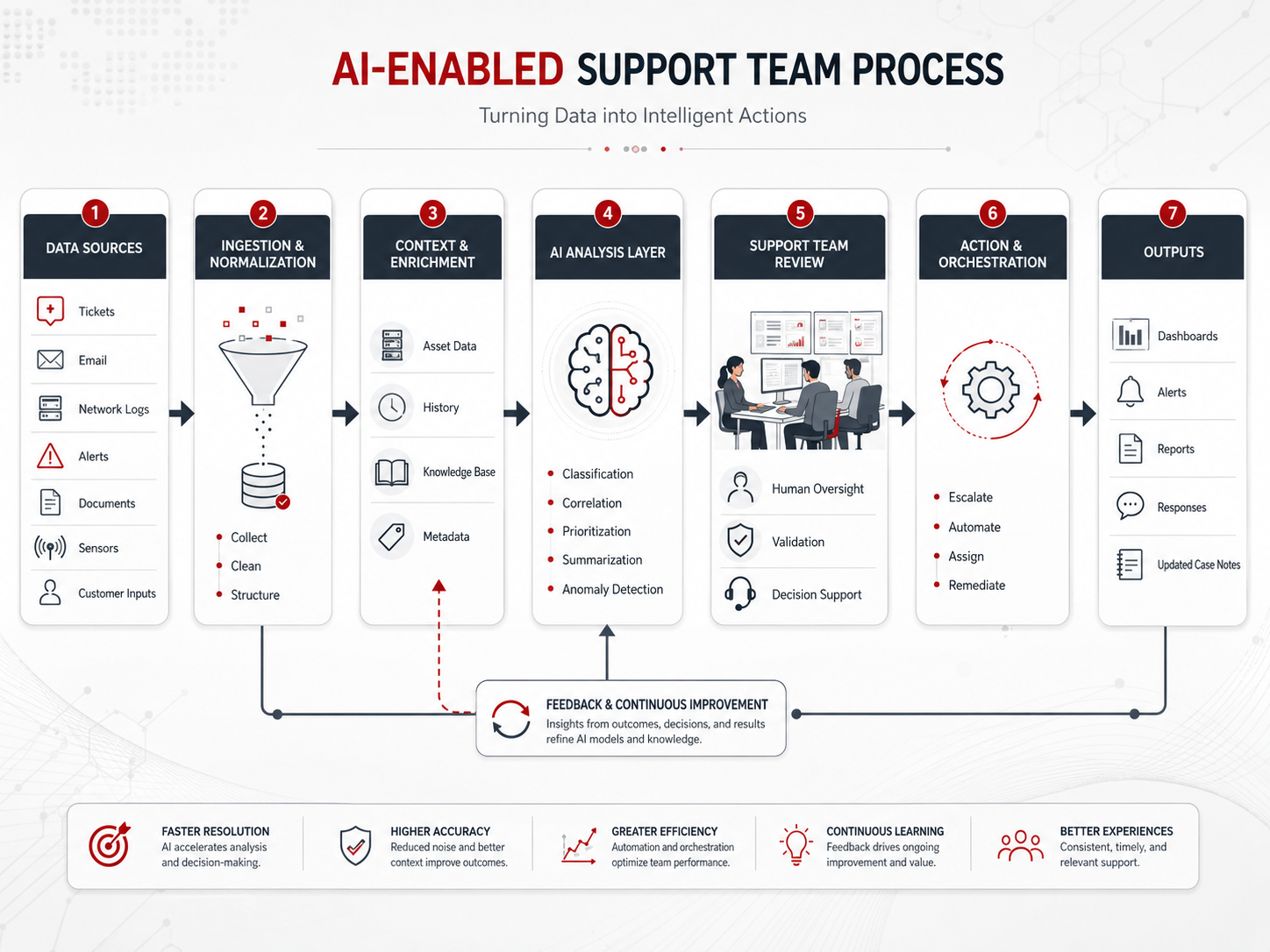
A practical architecture generally consists of five integrated layers.
3.1 Data and communications inputs
The system should identify the sources it is authorized to use. Sources may include network logs, sensor feeds, equipment status, ticketing systems, technical documentation, and operator inputs.
Data should be normalized before it is used by an AI model. Poorly structured, incomplete, duplicated, or stale data can reduce the usefulness of an otherwise capable model.
3.2 Local compute and storage
Edge compute should be selected according to the use case, environmental conditions, available power, storage requirements, and sustainment plan. The system may use ruggedized hardware, compact servers, workstations, or other platforms appropriate to the operating environment.
Hardware selection should not occur separately from application design. A model that performs well in an enterprise environment may require modification, compression, or a different inference strategy at the edge.
3.3 AI and automation services
AI services should have explicit purposes. Examples include anomaly classification, technical-document retrieval, event prioritization, maintenance recommendations, or workflow routing.
The system should define what the AI may do, what it may recommend, and what it may not decide. This distinction is important for safety, accountability, and acquisition clarity.
3.4 Human review and authorization
Human review should remain part of the design for consequential workflows. AI output should be treated as decision support unless the applicable program documentation and governance process authorize a different level of automation.
Operators should be able to understand the system’s status, limitations, confidence indicators, and available override or disengagement procedures. The DoD’s responsible AI principles identify reliability, traceability, and governability as essential characteristics of AI capabilities.
3.5 Synchronization and enterprise integration
The edge system should connect to enterprise services when permitted and technically feasible. Synchronization may include selected logs, model updates, configuration changes, approved data, and system-health information.
Open interfaces and documented APIs can reduce integration friction for primes. They also support future technology changes without requiring unnecessary replacement of existing infrastructure.

4. How should cybersecurity be built into edge AI?
Cybersecurity should be integrated before deployment. It should not be treated as a post-installation review.
The NIST Special Publication 800-207, Zero Trust Architecture, defines zero trust as an approach that does not grant implicit trust based solely on network location or asset ownership. Authentication and authorization are performed before access to a resource is established.
For tactical edge AI, this principle has practical implications:
- Verify users and devices. Human and machine identities should be authenticated through approved controls.
- Limit privileges. AI services, operators, administrators, and synchronization processes should receive only the access required for assigned functions.
- Segment systems. Data, management, operational technology, and user services should be separated according to risk and mission requirements.
- Protect data. Data should be encrypted in transit and at rest where applicable.
- Record activity. Local logging should continue during connectivity outages and synchronize when authorized.
- Control updates. Software, models, configurations, and policies should be signed, verified, and capable of rollback.
- Plan for compromise. The design should include containment, recovery, and reconstitution procedures.
Cybersecurity services for edge AI should address both the infrastructure and the model lifecycle. A secure network does not by itself ensure that training data, model updates, prompts, integrations, or AI outputs are trustworthy.
5. What should contracting officers and primes require?
Requirements should be written in measurable and operationally relevant terms. General language such as “provide an AI solution” does not adequately define performance, limitations, integration responsibilities, or acceptance criteria.
A solicitation, statement of work, or subcontract work package should address:
- Defined use cases. Identify the workflow, user population, data sources, operating conditions, and prohibited uses.
- Degraded-mode behavior. State which functions must continue during disconnected, bandwidth-limited, or partially failed conditions.
- Interface requirements. Require documented APIs, data formats, identity dependencies, and integration points.
- Security controls. Identify access control, logging, encryption, segmentation, update, and incident-response requirements.
- Test and evaluation. Require testing under representative latency, bandwidth, power, environmental, and cybersecurity conditions.
- Human oversight. Define approval, escalation, override, disengagement, and reporting procedures.
- Data and model documentation. Require appropriate descriptions of data provenance, model limitations, versioning, performance boundaries, and update history.
- Sustainment. Define training, field support, spare equipment, patching, monitoring, configuration management, and technical documentation.
- Acceptance evidence. Specify what test results, logs, demonstrations, and deliverables establish compliance.
The DoD Responsible AI Strategy and Implementation Pathway identifies acquisition lifecycle management, requirements validation, test and evaluation, workforce preparation, and continuous oversight as connected responsibilities. Primes should therefore evaluate an AI subcontractor on more than a demonstration. Integration discipline, documentation, field support, cybersecurity coordination, and sustainment capacity may determine whether the capability reduces or increases program friction.

6. What is a practical integration process?
A controlled implementation may follow this sequence:
- Define the mission requirement. Establish the operational problem before selecting a model or vendor.
- Map the system boundary. Identify users, devices, networks, data sources, external services, and authorization points.
- Select the edge workload. Keep only the data and functions that must operate locally.
- Prepare the data. Normalize, label, filter, and govern data before model deployment.
- Integrate cybersecurity controls. Apply identity, access, segmentation, encryption, logging, and update controls.
- Test under stress. Evaluate behavior during link loss, reduced bandwidth, equipment failure, malicious input, and data degradation.
- Train users and maintainers. Explain intended use, limitations, escalation procedures, and failure modes.
- Monitor and improve. Review performance, operator feedback, security events, and model changes throughout the lifecycle.
The process should produce a documented baseline. That baseline may include architecture diagrams, interface definitions, operating procedures, test results, model or data cards, configuration records, and sustainment responsibilities.
7. How can JPI Worldwide support a prime or government program?
JPI Worldwide provides AI and systems integration, network engineering, cybersecurity, communications, technical staffing, logistics, and field deployment support. These capabilities can be combined to address the practical dependencies that affect edge AI implementation.
For primes and contracting officers, JPI may support:
- AI-enabled workflow and process automation.
- Agent and systems integration.
- Data aggregation and operational visibility.
- Network and communications integration.
- Secure remote-access and infrastructure implementation.
- Field installation, commissioning, troubleshooting, and training.
- Technical personnel for CONUS and OCONUS requirements.
- Deployment coordination and sustainment support.
JPI’s experience across government, commercial, humanitarian, and international operating environments informs an approach based on the full operating requirement, including infrastructure, personnel, logistics, cybersecurity, and post-deployment support.
Contact JPI Worldwide
Organizations evaluating AI at the tactical edge, defense IT solutions, or cybersecurity services may contact JPI Worldwide to discuss a business, agency, or department requirement.
Do not submit classified information, Controlled Unclassified Information, export-controlled technical data, passwords, credentials, or other sensitive material through the public contact form. A secure communications method should be requested when the requirement requires one.