
Series: Article 1 of 5
Page label: Government Contracting Vehicles
Release date: September 28, 2026
Revision date: September 27, 2026
Author: Penny Marbel, JPI Worldwide
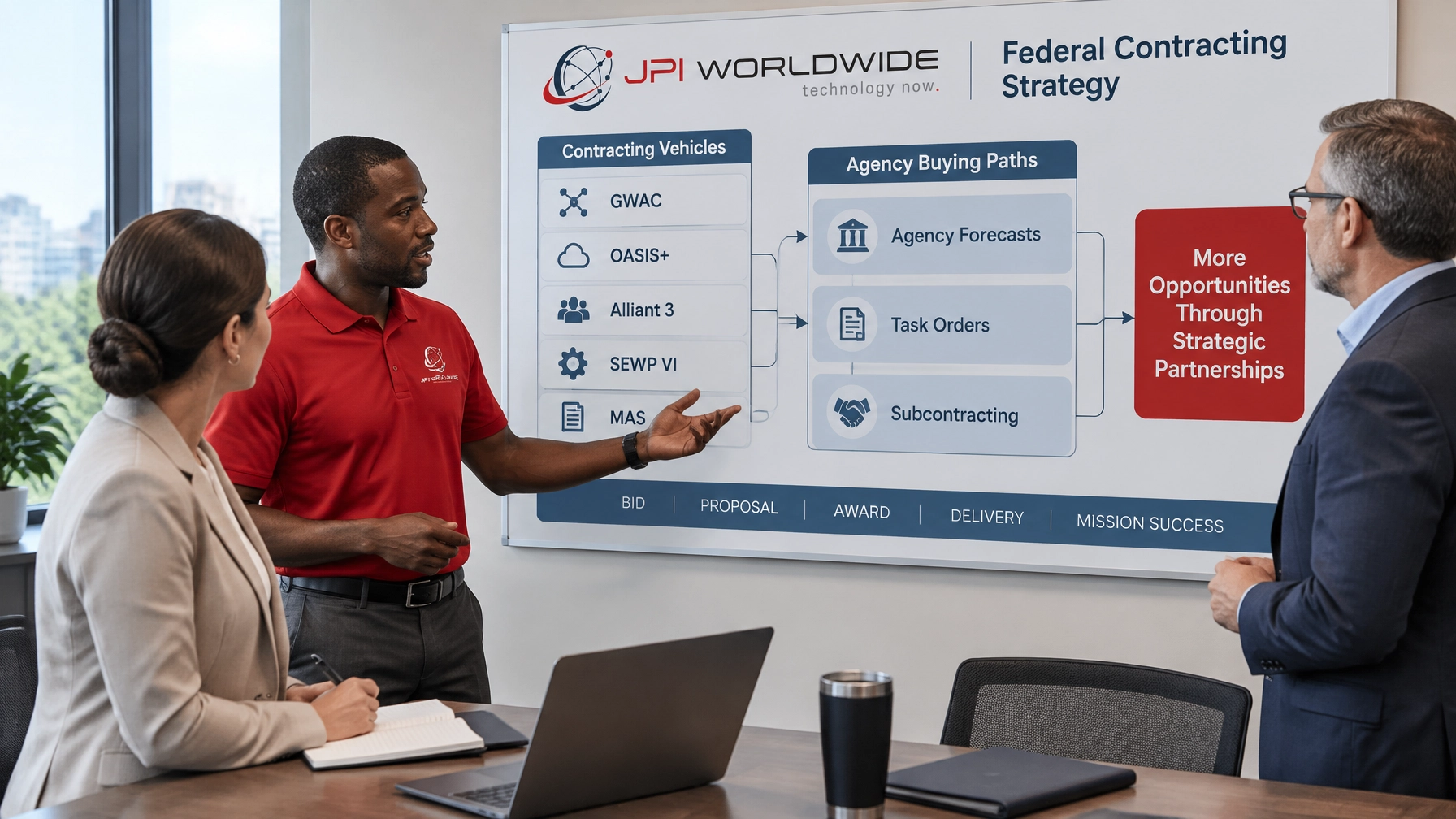
Government contracting vehicles are established purchasing arrangements that help federal agencies obtain recurring products and services from approved contractors.
For government buyers, a contract vehicle can provide an organized way to acquire goods or services without creating a completely new open-market procurement for every requirement. For government contractors and first-time subcontractors, a vehicle can determine which companies are eligible to compete, what terms apply, and how individual assignments will be issued.
A contract vehicle does not automatically create a funded project. The specific work generally begins when an agency issues a task order, delivery order, or other authorized order under the vehicle.
Quotable definition: A government contract vehicle is a contract, or group of contracts, that gives an agency a structured way to place multiple orders with a pre-selected vendor or group of vendors.
This article provides the foundation for a five-part series on government contracting vehicles. Later articles will address how vehicles are created, how contractors can pursue them, and how subcontractors can position themselves to support prime contractors.
1. What a contract vehicle does
A contract vehicle establishes the basic rules for future purchases. Those rules may address:
- The products or services that may be ordered.
- The agencies or authorized users that may place orders.
- The contractors eligible to compete.
- Pricing methods and labor categories.
- Periods of performance.
- Ordering procedures.
- Contract clauses and compliance requirements.
- Maximum contract value, minimum ordering obligations, or other limitations.
The vehicle is broader than a single project. It creates the purchasing framework. The individual requirement is defined later through an order or other authorized action.
The General Services Administration explains that contract vehicles provide a streamlined process for agencies to place multiple orders for certain products and services with a pre-selected vendor or group of vendors.
This structure may reduce repetitive administrative work. It does not eliminate the need for proper acquisition planning, funding, competition, technical evaluation, or contract administration.
2. Why the government establishes contract vehicles
Federal agencies establish or use contract vehicles when a repeatable purchasing structure may improve acquisition efficiency and control.
Common objectives include:
-
Reducing repetitive procurement activity. Agencies may use an existing vehicle rather than create a separate contract for every substantially related requirement.
-
Creating a qualified vendor pool. A vehicle may identify contractors that have already met defined eligibility, technical, administrative, or pricing requirements.
-
Supporting recurring requirements. Information technology, cybersecurity, professional services, logistics, communications, and infrastructure support may be needed repeatedly over several years.
-
Improving price and terms management. A vehicle may establish negotiated rates, labor categories, ordering procedures, and other baseline terms.
-
Preserving competition at the order level. Under a multiple-award vehicle, agencies may compete individual task orders among eligible contract holders.
-
Supporting socioeconomic and small-business objectives. Some vehicles or contract pools are restricted to qualifying small businesses or other designated categories.
A vehicle is therefore not simply a list of approved vendors. It is an acquisition mechanism with defined scope, authority, ordering procedures, and limitations.
3. IDIQ: the structural foundation
IDIQ means Indefinite Delivery, Indefinite Quantity. It is a contract structure used when the government knows it will need supplies or services but cannot determine the exact delivery schedule or total quantity at the time of award.
Quotable definition: An IDIQ is an umbrella contract that establishes terms for future orders when the government’s exact quantity, timing, or workload is not yet known.
An IDIQ normally establishes a period of performance, a scope of work, ordering rules, and a minimum and maximum value or quantity. The government is generally obligated only to the extent required by the contract and authorized orders, subject to the terms of the specific vehicle.
The actual work is defined through orders issued under the IDIQ. Services are commonly acquired through task orders. Supplies may be acquired through delivery orders.
Many widely used federal contract vehicles are structured as IDIQ contracts, including governmentwide acquisition contracts, multiple-award contracts, and the GSA Multiple Award Schedule.
The Federal Acquisition Regulation, Part 16 provides the principal regulatory framework for indefinite-delivery contracts and other contract types.

4. The principal types of contract vehicles
The terms below describe common federal purchasing structures. The exact scope and ordering rules depend on the solicitation and resulting contract.
Governmentwide Acquisition Contract
A Governmentwide Acquisition Contract, or GWAC, is a governmentwide, IT-focused IDIQ contract.
Quotable definition: A GWAC is a pre-competed governmentwide contract for information technology services and solutions that may be used by authorized federal agencies.
GWACs may cover areas such as systems design, software engineering, information assurance, enterprise architecture, cybersecurity, and related IT services. They are established by one agency or designated organization for broader federal use under applicable authority.
The GSA IT contract vehicle program identifies GWACs as sources for IT solutions, including enterprise architecture, information assurance, software engineering, and systems design.
A GWAC holder may compete for task orders issued by eligible agencies. Holding a GWAC does not guarantee that the contractor will receive orders.
Multiple Award Contract
A Multiple Award Contract, or MAC, is a vehicle awarded to more than one contractor.
Quotable definition: A MAC creates a vendor pool in which multiple contract holders may compete for individual task orders or delivery orders.
A MAC may be governmentwide, multi-agency, or limited to a particular agency or buying organization. The contract documents determine who may use it and which requirements may be competed.
Multiple-award structures allow the government to preserve competition after the base contracts have been awarded. The agency generally limits the order-level competition to eligible contractors within the vehicle, subject to applicable law and ordering procedures.
GSA Multiple Award Schedule
The GSA Multiple Award Schedule, commonly called the GSA Schedule or MAS, is a governmentwide catalog of commercial products and services offered under negotiated terms.
Quotable definition: The GSA MAS is a governmentwide contract program that gives eligible buyers access to commercial products and services through defined categories, terms, and pricing arrangements.
Schedule offerings are organized through Special Item Numbers, or SINs. A contractor must have an appropriate scope and comply with the applicable Schedule requirements before an agency may place an order.
The GSA MAS program provides access to millions of commercial products and services. Agencies may use Schedule procedures to request quotations and place orders, subject to applicable thresholds, competition requirements, and contract terms.
A Schedule contract creates an avenue to sell. It does not guarantee sales, task orders, or a particular level of government spending.
Blanket Purchase Agreement
A Blanket Purchase Agreement, or BPA, is a standing arrangement for recurring purchases from a qualified source or group of sources.
Quotable definition: A BPA is an agreement that simplifies repeat purchases by establishing terms for anticipated recurring needs.
BPAs may be established under a GSA Schedule or another existing contract vehicle. The government is generally obligated only when authorized orders, calls, or purchases are placed under the BPA.
A BPA can be useful when an agency expects repeated requirements but does not need to negotiate the full terms of each purchase from the beginning. The BPA remains subject to its scope, ceiling, ordering procedures, and applicable procurement rules.
Agency-specific indefinite-delivery vehicles
An agency-specific indefinite-delivery vehicle is an IDIQ or similar ordering arrangement established for one agency, bureau, department, or authorized group of users.
Quotable definition: An agency-specific vehicle is an ordering contract whose use is limited by the issuing agency’s scope, authority, and eligibility rules.
These vehicles may support specialized professional services, technical requirements, communications, logistics, facilities, or mission support. A contractor may be eligible for one agency-specific vehicle but not for a governmentwide vehicle.
Government buyers should confirm ordering authority before using an agency-specific vehicle outside the issuing organization.
5. Task orders are where the work is defined
A task order is the specific work assignment issued under a contract vehicle for services. A delivery order generally applies to supplies.
Quotable definition: A task order translates a broad contract vehicle into a funded requirement with defined work, deliverables, timelines, and price.
A task order may identify:
- The agency requirement.
- Statement of work or performance work statement.
- Period of performance.
- Labor categories or technical approach.
- Deliverables and acceptance criteria.
- Security, reporting, and compliance obligations.
- Contract type and pricing arrangement.
- Funding and invoicing instructions.
A contractor may hold a vehicle and still receive no work unless the government issues an order. Conversely, an agency may use a vehicle for several orders with different scopes, funding sources, periods of performance, and performance requirements.
Subcontractors should also understand the distinction. A subcontractor may not hold the vehicle directly. Instead, the subcontractor may support a prime contractor that holds the vehicle and receives a task order.

6. How contractors and subcontractors relate to vehicles
A prime contractor generally seeks a direct position on a vehicle or competes for task orders as a contract holder. A subcontractor may participate through a prime contractor, team arrangement, or approved subcontracting structure.
First-time subcontractors should evaluate:
- Which primes hold relevant vehicles.
- Whether the company’s capabilities fit the vehicle scope.
- Whether the prime has recurring task-order demand.
- Whether the subcontract requires additional flow-down clauses.
- Whether accounting, cybersecurity, insurance, staffing, and reporting systems are adequate.
- Whether the proposed work supports the company’s approved labor categories and pricing.
A vehicle association is not a substitute for contract readiness. Government contractors must still maintain accurate representations, appropriate registrations, compliant accounting, qualified personnel, and the ability to perform the specific order.
7. A practical distinction for government buyers
Government buyers should separate three questions:
- Is the requirement within the vehicle’s scope?
- Is the agency or buying organization authorized to use the vehicle?
- Has the required order-level procedure been completed?
A vehicle may simplify acquisition, but the buyer must still follow the vehicle contract, the FAR, agency supplements, funding restrictions, competition requirements, and other applicable authorities.
The GSA acquisition resources provide access to vehicle information, vendor resources, and ordering systems. The System for Award Management remains the principal federal system for contractor registration and contract opportunity information.
8. Frequently asked questions
Is a contract vehicle the same as a government contract?
Not necessarily. A vehicle may consist of one contract or a group of contracts that supports future orders. The specific task order or delivery order defines the individual requirement.
Does holding a vehicle guarantee revenue?
No. Vehicle holders may compete for orders, but the government generally does not guarantee a particular sales volume unless the contract states otherwise.
Can a subcontractor be associated with a vehicle?
Yes. A subcontractor may support a prime contractor that holds the vehicle. The subcontractor’s rights and obligations arise from the subcontract and applicable flow-down provisions.
Are all contract vehicles IDIQs?
No. Many major vehicles are structured as IDIQs, but the applicable contract documents determine the legal structure and ordering method.
What is the difference between a GWAC and a GSA Schedule?
A GWAC is focused on governmentwide IT services and solutions. A GSA Schedule is a broader catalog of commercial products and services organized by categories and SINs. Both may support streamlined ordering, but their scopes and procedures differ.
9. How JPI Worldwide can support vehicle-based work
JPI Worldwide supports government contractors and prime contractors with communications, networking, artificial intelligence integration, cybersecurity, technical infrastructure, and field technology services.
For primes, a capable subcontractor can reduce operational friction by supporting defined technical work, staffing requirements, deployment coordination, documentation, and performance obligations under task orders. For government buyers, disciplined subcontractor performance may contribute to clearer execution and more consistent delivery.
To discuss how JPI Worldwide may support your business, agency, department, prime contract, or task-order requirement, contact JPI Worldwide through the company website.