Page: Government Contracting Insights
Series: Article 5 of 5
Author: Penny Marbel, JPI Worldwide
Revision date: September 27, 2026
The federal contracting vehicle landscape is changing. New government-wide acquisition contracts are becoming operational while existing vehicles are being consolidated, transferred, or retired. For government contractors and defense IT solutions providers, the practical consequence is clear: contract access must be treated as a portfolio strategy rather than a single-event decision.
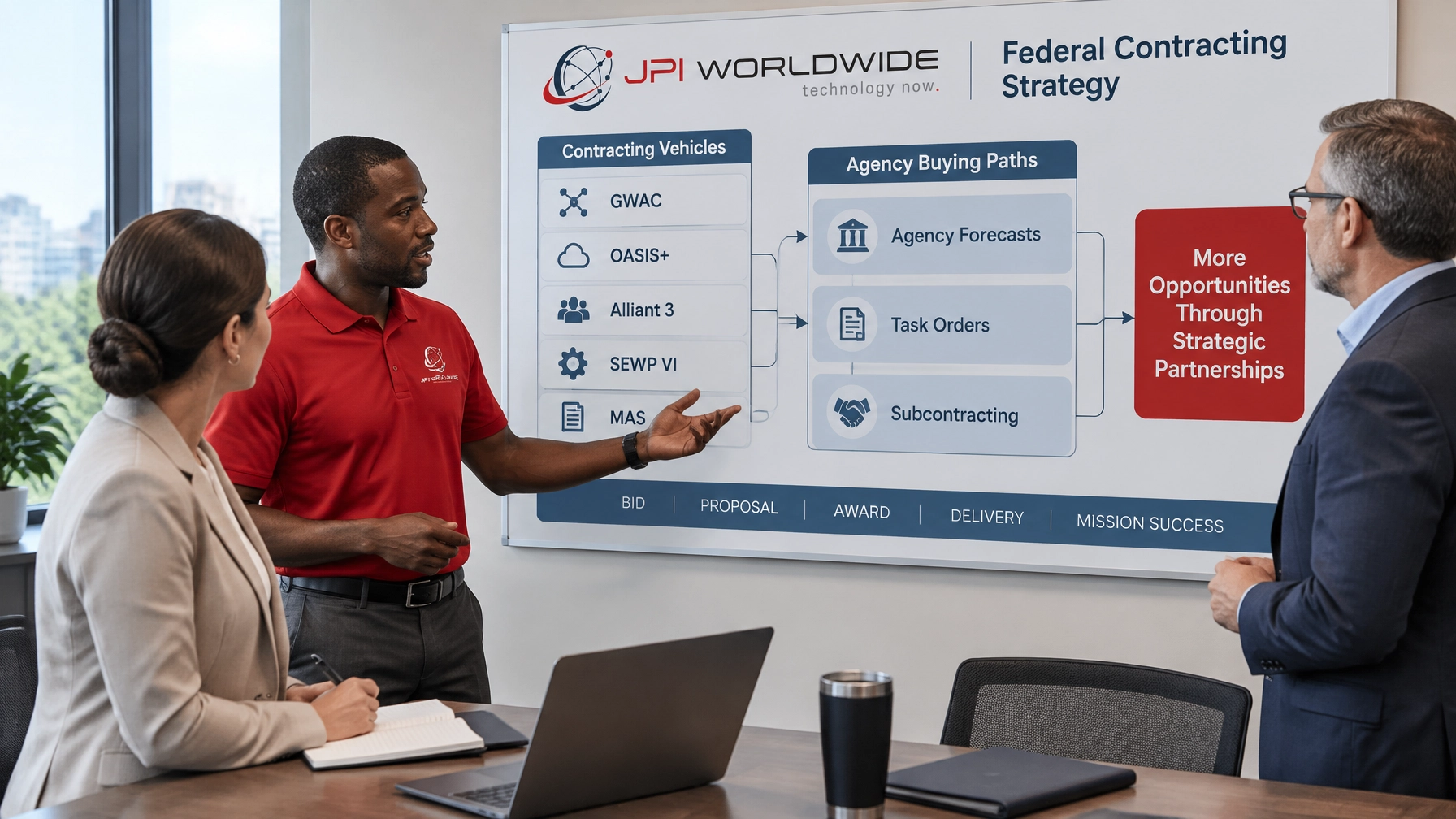
Alliant 3, OASIS+, SEWP VI, and the CIO-SP program illustrate different forms of change. Some vehicles are expanding access through phased awards or rolling admissions. Others are moving between managing organizations. Some are being discontinued as agencies align information technology acquisitions with a more consolidated government-wide structure.
Small businesses should understand the change without assuming that consolidation eliminates subcontracting opportunities. In many cases, the opposite may be true. Prime contractors will continue to require specialized technical capabilities, field execution, infrastructure support, and compliant delivery partners that can reduce operational friction under active task orders.
1. What a contracting vehicle is
A contracting vehicle is a pre-established contract or contract program that allows an agency to acquire defined goods or services under established terms, ordering procedures, and competition requirements.
Quotable definition: “A government contracting vehicle is a pre-established acquisition structure that gives eligible agencies an authorized path to order specific goods or services from qualified contractors.”
A vehicle may define:
- The scope of work that may be ordered.
- The contractors eligible to receive task or delivery orders.
- The ordering procedures and competition requirements.
- The contract ceiling, pricing structure, and period of performance.
- Small-business eligibility or set-aside requirements.
- Reporting, security, technical, and administrative obligations.
A government-wide acquisition contract, or GWAC, is one type of vehicle. A multiple-award contract, agency contract, blanket purchase agreement, and schedule contract may serve different purposes. The vehicle does not itself guarantee revenue. It creates an authorized channel through which future requirements may be competed or ordered.
The distinction is important. A company may hold a prime contract and still need additional firms to satisfy a task order’s technical, geographic, staffing, or small-business requirements.
2. What the 2026 landscape shows
The current landscape demonstrates four related developments.
Alliant 3 is operational
GSA’s Alliant 3 is a government-wide IT acquisition contract. Phase 1 awards have been issued, the awarded contracts are live, and orders are being placed. GSA continues evaluating proposals for subsequent phases.
This phased structure means that contractors should distinguish between:
- Eligibility under the current awarded pool.
- Continued consideration for subsequent phases.
- The ability of agencies to place orders now.
- The competitive position of individual awardees on future task orders.
For government buyers, Alliant 3 may provide a current path for enterprise IT requirements, subject to scope, ordering guidance, and applicable competition procedures. For contractors, the vehicle should be evaluated according to actual agency buying behavior rather than its government-wide designation alone.
OASIS+ uses rolling admissions
OASIS+ is GSA’s professional services vehicle. Its active model uses continuously open solicitations, rolling admissions, and awards issued in phases. The structure is intended to permit qualified offerors to submit proposals during the open period, subject to the applicable solicitation requirements and amendments.
This changes the timing assumption associated with a traditional one-time vehicle competition. A company that is not ready to pursue OASIS+ immediately should not assume that the opportunity has permanently closed. At the same time, continuous availability does not reduce the need for disciplined preparation. Proposal quality, socioeconomic eligibility, relevant experience, and compliance with the current solicitation remain material.
SEWP VI is moving between managing organizations
SEWP VI follows another pattern. Following its award, the vehicle is being transitioned to GSA for management. The award and the management transition are separate issues. Contractors and government buyers should monitor official program notices for changes to ordering procedures, points of contact, systems, and administrative responsibilities.
A management transition may affect how agencies and vendors access information, interpret guidance, and coordinate contract administration. It does not eliminate the need to review the operative contract documents and current ordering instructions.
CIO-SP4 was cancelled
CIO-SP4 was cancelled, and NITAAC is transitioning its existing CIO-SP3 contract and related task orders to GSA as the federal IT contracting structure is consolidated.
This example establishes an important planning rule: a solicitation that has received substantial industry attention may still be discontinued when the government determines that its requirements are duplicative, outdated, or better addressed through another vehicle structure.

3. Why the government establishes and consolidates vehicles
The government uses contracting vehicles to create repeatable acquisition channels. A well-designed vehicle may reduce administrative duplication, establish common terms, improve market access, and provide agencies with a qualified contractor pool.
Consolidation may also seek to:
- Reduce overlapping contract programs.
- Standardize ordering and contract administration.
- Improve visibility into government-wide spending.
- Concentrate acquisition expertise.
- Support category management and best-in-class purchasing goals.
- Reduce the number of separate systems and administrative processes.
Consolidation also creates transition risk. Agencies must understand which vehicle remains available, which organization manages it, and whether existing orders continue under their current terms. Contractors must track changes without assuming that a vehicle’s prior reputation will determine its future relevance.
Quotable definition: “Consolidation does not mean that every requirement will move to one contract. It means that contractors and buyers must evaluate the current authorized path for each requirement.”
4. What consolidation means for small business
Small businesses should not build a market strategy around one vehicle. A vehicle may be cancelled, transferred, amended, closed to new proposals, or rendered less relevant by agency buying behavior.
A durable strategy should include several access routes:
- Direct prime-contract opportunities.
- Subcontracting positions under active vehicle holders.
- Agency-specific contracts and task orders.
- Small-business set-aside pools.
- Socioeconomic programs for which the company is eligible.
- Commercial and defense-adjacent customers that strengthen past performance.
Small businesses should also distinguish vehicle access from task-order competitiveness. Holding a place on a vehicle is only one part of the process. The company must still demonstrate relevant experience, pricing discipline, staffing capacity, delivery controls, and the ability to support the prime’s contractual obligations.
For a small technical firm, subcontracting may be the most practical entry point. A subcontractor can contribute network engineering, cybersecurity, communications, AI integration, technical staffing, logistics, or field deployment without carrying the entire prime-contract administration burden.

5. Contractor action plan
Government contractors should take the following steps.
Monitor authoritative sources
Review SAM.gov notices, amendments, award announcements, and opportunities. Monitor GSA vehicle pages and the forecast sites of target agencies. A vehicle strategy based only on commercial market commentary may not reflect the current solicitation or ordering status.
Identify actual agency buying behavior
Determine which vehicles target agencies actually use for the relevant service category. A government-wide vehicle may be broad in scope but less useful to a company if the target agencies rarely order against it.
Maintain relevant eligibility
Review eligibility for applicable small-business programs, including socioeconomic programs administered through the Small Business Administration. Registration status, representations, certifications, and supporting records should be kept current where applicable.
Build past performance deliberately
Past performance should be tied to the work the company intends to pursue. Document the technical scope, customer outcome, staffing role, delivery conditions, period of performance, and measurable results to the extent permitted.
Pursue live subcontracting positions
Identify prime contractors holding active vehicles and review their teaming or supplier requirements. A subcontracting position may provide access to task-order work, customer references, and performance evidence that support later prime pursuits.
Prepare for administrative change
Vehicle transitions can affect templates, points of contact, ordering portals, reporting requirements, and proposal timing. Contractors should assign responsibility for monitoring these changes and should not rely on outdated internal reference material.
6. Government buyer action plan
Government buyers should select a vehicle based on the requirement, not on the vehicle’s name or general market visibility.
The evaluation should address:
- Whether the requirement is within the vehicle’s scope.
- Whether the vehicle supports the required contract type and ordering method.
- Whether the available contractor pool includes the needed technical capabilities.
- Whether small-business or socioeconomic objectives apply.
- Whether the vehicle supports the required schedule and period of performance.
- Whether competition and fair-opportunity procedures are satisfied.
- Whether the vehicle’s current management and transition status are understood.
A small-business subcontractor may reduce operational friction when the prime contractor needs specialized capability, additional field personnel, geographic reach, or technical surge capacity. Government buyers should recognize that a capable small-business teammate can strengthen execution without changing the prime contractor’s contractual accountability.
For requirements involving communications, network infrastructure, cybersecurity, AI integration, technical staffing, logistics, or deployment support, the relevant question is often not whether a small firm can perform every function. The question is whether the firm can perform a defined portion of the requirement reliably within the prime’s delivery model.
7. The five-part series in summary
This five-part series addressed the contracting vehicle lifecycle:
- What contracting vehicles are: The structure, purpose, and terminology.
- Why agencies use them: The relationship between vehicles, competition, efficiency, and acquisition planning.
- How contractors gain access: Eligibility, proposal preparation, registrations, certifications, and teaming.
- How task-order work is won and delivered: Competition, pricing, past performance, compliance, and execution.
- What the 2026 landscape requires: Monitoring consolidation, diversifying access, and building a practical vehicle strategy.
The central conclusion is straightforward. Contract vehicles are access mechanisms, not business plans. Contractors should maintain multiple paths to qualified work. Government buyers should select the vehicle that best supports the requirement, ordering rules, competition, and mission outcome.

8. How JPI can support a vehicle team
JPI Worldwide supports government agencies, prime contractors, and subcontracting teams with communications, networking, cybersecurity, AI and systems integration, technical staffing, logistics, and field deployment capabilities.
JPI can serve as a specialized subcontractor when a prime requires technical personnel, infrastructure support, systems integration, deployment coordination, or sustained operational assistance. Its role may be structured around a defined work package, task-order requirement, or field-support function.
Potential partners and government buyers may contact JPI Worldwide to discuss a business, agency, or department requirement. JPI’s government capabilities and integrated technology capabilities provide additional information about available support areas.
Public inquiries should not include classified information, Controlled Unclassified Information, credentials, export-controlled technical data, or other sensitive material.