
Author: Penny Marbel

  • FAR 52.225-19: What “Contractor Personnel Are Civilians” Means for OCONUS Missions

    FAR 52.225-19: What “Contractor Personnel Are Civilians” Means for OCONUS Missions

    Page label: Government Contracting
    Revision date: August 31, 2026
    Author: Penny Marbel (JPI Worldwide)

    FAR 52.225-19 establishes requirements for contractor personnel performing outside the United States in a designated operational area or while supporting certain diplomatic or consular missions. The clause addresses personnel status, use of force, logistics, security, legal compliance, readiness, accountability, weapons, evacuation, and subcontracting.

    The clause also states directly that “Contractor personnel are civilians.”

    That statement is important, but it does not remove the operational, legal, or contractual obligations that apply to civilian personnel supporting an overseas government mission. For primes and contracting officers, the clause should be understood as a framework for managing contractor performance in environments where military, diplomatic, government, and commercial personnel may operate together under different authorities.

    This article provides a general explanation of FAR 52.225-19. The contract, solicitation, statement of work, applicable agency procedures, and current law control in each matter.

    1. When Does FAR 52.225-19 Apply?

    FAR 52.225-19 applies when contractor personnel are required to perform outside the United States in specified operational or diplomatic settings.

    Under FAR 25.301-4, the clause is inserted in solicitations and contracts, other than personal service contracts with individuals, that require contractor personnel to perform:

    • In a designated operational area during a contingency operation.
    • In a designated operational area during a humanitarian or peacekeeping operation.
    • In a designated operational area during another military operation or a military exercise designated by the combatant commander.
    • In support of a diplomatic or consular mission designated by the Department of State as a danger-pay post.
    • In support of a diplomatic or consular mission that the contracting officer determines should be subject to the clause.

    A contract performed overseas does not automatically create the same obligations in every case. The contracting officer should evaluate the place of performance, mission type, contract structure, and applicable agency requirements before determining whether FAR 52.225-19 is required.

    The clause may also be accompanied by additional requirements in the contract, statement of work, theater instructions, agency policies, or applicable supplements.

    FAR 52.225-19 applicability flow from overseas performance to designated operational areas or covered diplomatic missions

    2. What Does “Contractor Personnel Are Civilians” Mean?

    The phrase means that contractor personnel do not become members of the armed forces merely because they work in a designated operational area or near military personnel.

    Definition: For purposes of FAR 52.225-19, contractor personnel remain civilian personnel and must operate within the authority granted by the contract, applicable law, their position, and approved mission procedures.

    Civilian status has practical consequences.

    Contractor personnel generally:

    • Do not exercise military command authority.
    • Do not receive authority to issue military orders solely because of their contract position.
    • Do not become active-duty service members through overseas contract performance.
    • Must remain distinguishable from military personnel where military clothing is authorized.
    • Must comply with applicable government, host-country, and third-country requirements.
    • Must follow force-protection, health, safety, and security instructions issued by the appropriate government authority.

    The clause also states that service performed under the clause is not active duty or service under the specified veterans’ statutory provision. Civilian personnel may support military or diplomatic missions without being part of the military chain of command.

    For primes, this distinction should be reflected in position descriptions, training, supervision, identification procedures, and subcontract terms. For contracting officers, it should be reflected in the statement of work and the administration of the contract.

    3. What Are the Rules on Use of Force?

    FAR 52.225-19 limits the use of deadly force by contractor personnel.

    Except for the specific security-function provision in the clause, contractor personnel are authorized to use deadly force only in self-defense and in accordance with the applicable contract requirements. Contractor personnel performing security functions may have additional authority when deadly force reasonably appears necessary to execute the approved security mission to protect persons or assets.

    The distinction is narrow and important.

    A contractor’s technical, logistics, communications, maintenance, or administrative role does not create security authority. A contract employee may not assume that carrying equipment, working near military personnel, or operating in a dangerous environment permits the use of force beyond the authority expressly provided.

    Where weapons are authorized, the clause requires additional controls. The contracting officer, subject to required approval, may authorize the carrying of weapons. The contractor must provide a specific list of personnel for whom authorization is requested and must ensure that authorized personnel:

    • Are trained to carry and use weapons safely.
    • Understand and follow the applicable rules for the use of force.
    • Comply with applicable law, policy, agreements, and agency requirements.
    • Are not prohibited from possessing firearms under applicable federal law.
    • Follow instructions concerning possession, use, safety, and accountability.

    Weapon authorization is not a general contractor privilege. It is a controlled contract and mission requirement.

    4. Who Is Responsible for Logistics and Security Support?

    Unless the contract provides otherwise, the contractor is responsible for the logistical and security support required for its personnel.

    This obligation may affect pricing, staffing, mobilization schedules, travel planning, insurance considerations, equipment movement, and subcontract management. A prime should not assume that the government will provide every support function required for contractor performance.

    The contract should be reviewed for requirements involving:

    • Transportation and movement between processing points.
    • Lodging, food, water, and sustainment.
    • Security support and personal protective measures.
    • Medical readiness and evacuation arrangements.
    • Communications and emergency contact procedures.
    • Equipment staging, replacement, and resupply.
    • Personnel accountability and emergency data.
    • Country, theater, or special-area clearances.

    The clause permits the government to direct processing through designated departure or reception centers and to establish procedures for personnel data. Contractor personnel lists and emergency contact information must be maintained as required by the contract.

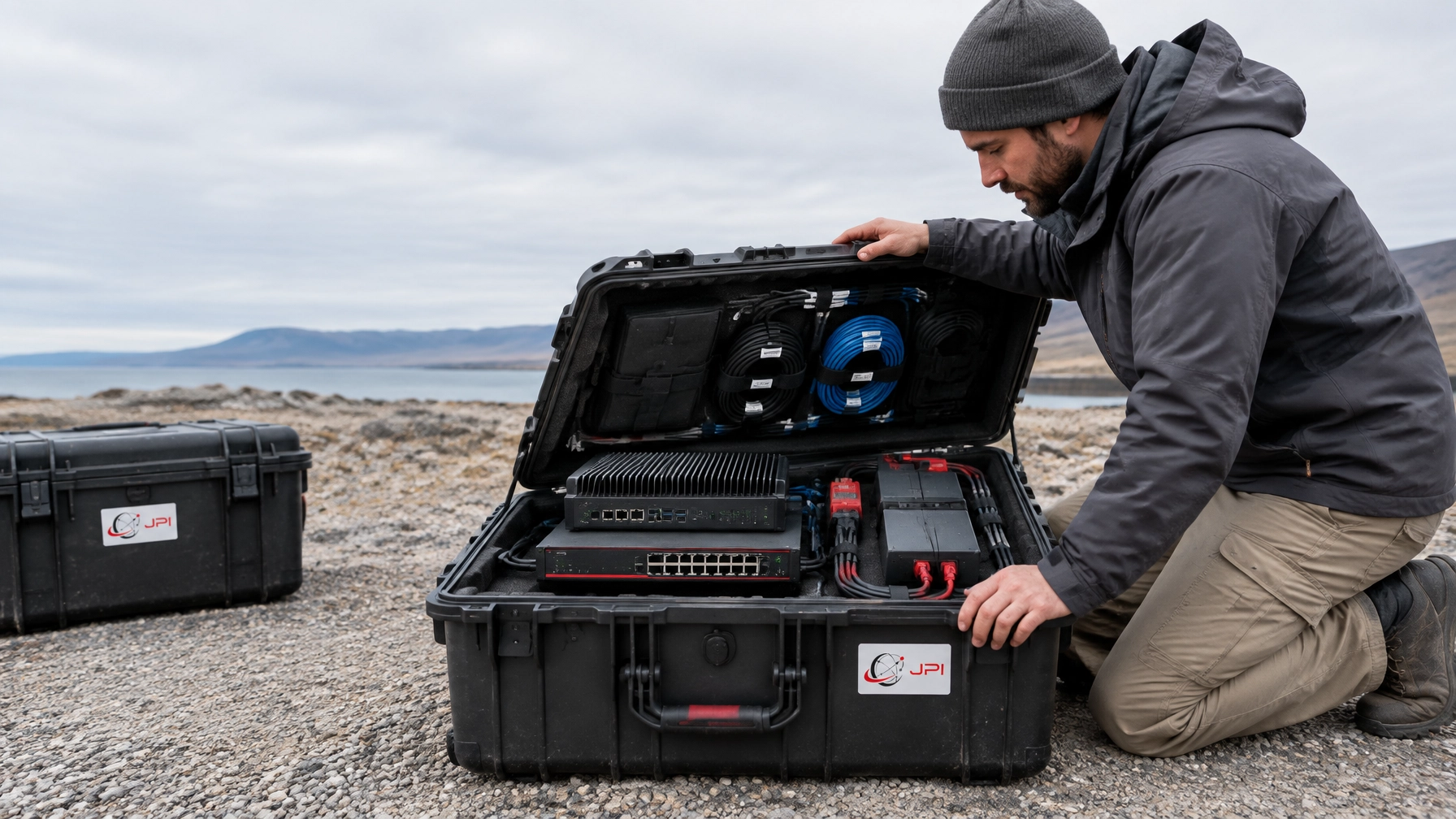
    Civilian technical professionals inspecting equipment cases and deployment documents in a controlled staging workspace

    5. What Must Be Completed Before Deployment?

    FAR 52.225-19 establishes preliminary personnel requirements. The specific requirements are set out in the statement of work or elsewhere in the contract.

    Before departure, or before beginning performance in the applicable area, the contractor must ensure that required conditions are satisfied. These may include:

    • Completion and acceptance of security and background checks.
    • Medical and physical fitness.
    • Required vaccinations.
    • Passports, visas, entry permits, and transit documentation.
    • Country or special-area clearance, when required.
    • Theater clearance, when required.
    • Personal security training.
    • Isolated personnel training, when specified.
    • Registration with the responsible U.S. embassy or consulate for applicable U.S. citizens.

    The contractor must also notify personnel who are not host-country nationals or ordinarily resident in the host country that certain U.S. criminal laws may apply to conduct outside the United States. Depending on the circumstances, the Military Extraterritorial Jurisdiction Act, the War Crimes Act, and other federal statutes may be relevant.

    These requirements should be treated as deployment gates rather than administrative afterthoughts. A person who is technically qualified but lacks required documentation, clearance, training, or medical readiness may not be eligible to begin performance.

    OCONUS personnel readiness checklist showing security checks, medical readiness, travel documents, clearances, training, and accountability

    6. How Does the Clause Affect Primes and Subcontractors?

    Paragraph (q) requires the contractor to incorporate the substance of FAR 52.225-19, including the subcontracting paragraph, in covered subcontracts that require personnel to perform outside the United States.

    This creates a direct compliance obligation for primes. Subcontractors should be evaluated before mobilization, not only after award. The prime should confirm that each subcontractor can support the applicable requirements for personnel, logistics, security, documentation, training, reporting, and emergency response.

    A prime’s review may include:

    • Whether the subcontractor’s scope requires overseas performance.
    • Whether the subcontractor has identified all covered personnel.
    • Whether the subcontract includes the required clause substance.
    • Whether personnel can satisfy contract-specific readiness requirements.
    • Whether the subcontractor understands government processing and reporting procedures.
    • Whether the subcontractor has planned for equipment, travel, communications, and sustainment.
    • Whether records can be produced for contract administration and oversight.

    The contracting officer may direct the contractor to remove and replace personnel who fail to comply with applicable contract requirements. Such action may occur without limiting other contractual remedies, including termination for default or cause.

    The contracting officer may modify contract terms only through the authority provided by the contract and applicable procedures. A force-protection instruction does not, by itself, authorize a contractor or other government personnel to change the contract’s terms and conditions.

    7. Why Does FAR 52.225-19 Matter for Technology Infrastructure?

    OCONUS technology work depends on more than equipment delivery. Communications, networks, cybersecurity systems, and technical infrastructure must be installed, configured, secured, tested, supported, and sustained by personnel who satisfy the applicable deployment requirements.

    A technical subcontractor may need to coordinate:

    • Network and communications installation.
    • Secure access and system configuration.
    • Field troubleshooting and commissioning.
    • Equipment staging and movement.
    • Personnel documentation and readiness.
    • Customer training and operational handoff.
    • Maintenance and replacement equipment.
    • Coordination with prime-contractor, government, and local teams.

    For a prime, the practical objective is to reduce the risk that a technically sound solution is delayed by incomplete readiness, unclear responsibilities, or poorly coordinated field support.

    JPI Worldwide supports government agencies and prime contractors with network engineering and infrastructure, cybersecurity, systems integration, technical staffing, logistics, and CONUS and OCONUS field services. JPI’s government support capabilities are structured to support work from design and procurement through installation, testing, troubleshooting, and sustainment.

    8. What Should Contracting Officers and Primes Review?

    Before performance begins, the applicable contract documents should be reviewed as an integrated set.

    The review should address:

    1. Applicability: Whether FAR 52.225-19 is required based on the place and nature of performance.
    2. Scope: Whether the statement of work identifies the covered personnel and operating environment.
    3. Support: Which logistical, security, medical, transportation, and evacuation responsibilities remain with the contractor.
    4. Readiness: Which clearances, training, documentation, and health requirements must be completed.
    5. Authority: What contractor personnel may and may not do under their assigned roles.
    6. Accountability: How personnel lists, emergency data, reporting, and replacements will be managed.
    7. Subcontracts: Whether covered subcontracts contain the required clause substance.
    8. Changes: Which actions require a written direction or contract modification from the contracting officer.

    The review should be completed before mobilization. Responsibilities that remain undefined may create avoidable schedule, cost, safety, and performance risks.

    Conclusion

    FAR 52.225-19 does not treat contractor personnel as military personnel. It establishes a controlled framework for civilian performance in designated operational areas and covered diplomatic or consular missions outside the United States.

    The central rule is straightforward:

    Contractor personnel are civilians, but civilian status does not eliminate contractual, legal, security, readiness, or accountability requirements.

    For primes and contracting officers, effective administration depends on clear scopes of work, appropriate subcontract flow-downs, documented readiness procedures, defined support responsibilities, and disciplined personnel accountability.

    JPI Worldwide can discuss how its communications, network infrastructure, cybersecurity, systems integration, technical staffing, logistics, and field deployment capabilities may support a business, agency, department, prime contract, or subcontract requirement. Use the JPI contact page, email connect@jpiworldwide.com, or call +1-509-210-3023. Do not submit classified information, Controlled Unclassified Information, export-controlled technical data, credentials, or other sensitive material through the public contact form.

    Sources

  • Defense Base Act Insurance, Explained: What Every Deployed Contractor Should Know

    Defense Base Act Insurance, Explained: What Every Deployed Contractor Should Know

    Page label: Government Contracting Insights
    Revision date: August 31, 2026
    Author: Penny Marbel (JPI Worldwide)

    Defense Base Act insurance is a workers’ compensation requirement that may apply when government contractors and subcontractors perform work outside the United States. For first-time subcontractors, the requirement can affect proposal pricing, employee deployment, subcontract flowdowns, incident response, and contract administration.

    The Defense Base Act, or DBA, is not a general travel policy. It is a statutory workers’ compensation framework connected to specific overseas work and contract conditions. Coverage should be confirmed before personnel begin performance.

    This article provides general information for government contractors. It does not replace the contract, legal advice, advice from an insurance professional, or direction from the Department of Labor.

    1. What is Defense Base Act insurance?

    Defense Base Act insurance is workers’ compensation coverage for certain civilian employees working outside the United States in connection with covered government contracts and activities.

    The DBA extends the protections of the Longshore and Harbor Workers’ Compensation Act to specified classes of overseas employees. The program is administered by the U.S. Department of Labor’s Office of Workers’ Compensation Programs.

    Depending on the applicable circumstances, benefits may include:

    • Medical care for covered work-related injuries or illnesses.
    • Disability compensation.
    • Death benefits for eligible survivors.
    • Protection related to certain war-hazard risks, including injury, death, capture, or detention.

    The Department of Labor’s explanation of the Defense Base Act provides an overview of coverage categories and administrative requirements.

    DBA insurance is generally purchased through an authorized insurance carrier. A contractor may also seek to qualify as a self-insurer, subject to applicable approval requirements.

    Civilian contractor reviewing a contract binder and insurance checklist in a generic field office

    2. Who may need DBA coverage?

    DBA coverage may apply to employees working overseas under several categories of government-related work. The precise determination depends on the contract, funding source, work location, duties, employee status, and any applicable waiver.

    Common categories include personnel performing:

    • Public works contracts outside the United States.
    • National defense or military support activities overseas.
    • Work on a U.S. military base or other location used by the United States for military purposes.
    • Contracts approved or financed under the Foreign Assistance Act.
    • Certain services funded by the U.S. government outside normal military channels.

    The requirement may extend to:

    • Prime contractor employees.
    • Subcontractor employees.
    • U.S. citizens and nationals.
    • Third-country nationals.
    • Local nationals, unless an applicable waiver or other legal provision changes the requirement.

    A subcontractor should not assume that a worker is excluded because the worker is not a U.S. citizen or because the subcontractor has commercial workers’ compensation coverage in the United States.

    The relevant question is whether the employee and the work fall within the DBA framework. That question should be reviewed against the contract and applicable law before mobilization.

    3. Which contract clauses should government contractors review?

    The contract should be reviewed for the applicable Federal Acquisition Regulation clauses. Two clauses are particularly important.

    FAR 52.228-3

    FAR 52.228-3, Workers’ Compensation Insurance (Defense Base Act) generally requires the contractor, before commencing performance, to establish provisions for disability compensation, medical benefits, and death benefits for covered employees.

    The contractor must do so by either:

    • Purchasing workers’ compensation insurance; or
    • Qualifying as a self-insurer under the Longshore and Harbor Workers’ Compensation Act as extended by the DBA.

    The clause also requires the contractor to maintain the applicable provisions through contract performance. It includes reporting and claims-administration obligations, including the submission of Form LS-202 within the specified period after an injury or death becomes known.

    The clause must be flowed down in applicable subcontracts.

    FAR 52.228-4

    FAR 52.228-4, Workers’ Compensation and War-Hazard Insurance Overseas, addresses situations in which the Secretary of Labor has waived DBA applicability for certain employees, locations, contracts, or classifications.

    A waiver does not necessarily eliminate all responsibility for employee protection. The clause may require alternative workers’ compensation coverage and protection for war-hazard risks.

    The contractor should not treat the presence of a waiver as a complete removal of insurance obligations. The waiver’s scope and conditions must be reviewed.

    The acquisition framework is summarized in FAR Subpart 28.3, including FAR 28.305 and FAR 28.309.

    4. Does ordinary workers’ compensation cover an overseas deployment?

    Ordinary domestic workers’ compensation should not be assumed to satisfy DBA requirements.

    A domestic policy may contain geographic, occupational, contractual, or war-risk limitations. It may also be unsuitable for the reporting, benefit, and claims requirements that apply under the DBA.

    Coverage should be evaluated for:

    • The actual country or countries of performance.
    • The contract and subcontract structure.
    • The employee classifications involved.
    • The nature of the work.
    • The expected deployment period.
    • Travel and transit arrangements.
    • War-hazard exposure.
    • Medical evacuation and related assistance, where applicable.
    • The use of local or third-country personnel.

    A contractor should obtain written confirmation from its insurance professional that the proposed coverage addresses the applicable DBA requirements. The contractor should retain that confirmation with the contract file.

    5. What is the difference between DBA coverage and war-zone insurance?

    DBA insurance is a statutory workers’ compensation mechanism. War-zone or high-risk insurance may refer to additional coverage designed for elevated operational risks.

    The terms are not interchangeable.

    DBA coverage may provide benefits for covered employment-related injury, illness, disability, or death. Under the federal framework, war-hazard protections may also apply in connection with DBA coverage. The specific operation of those protections depends on the applicable statute, contract, policy, and facts.

    Additional insurance may address other exposures, such as:

    • Evacuation or repatriation.
    • Political violence.
    • Kidnap and ransom.
    • Accidental death and dismemberment.
    • Emergency medical support.
    • Vehicle or general liability.
    • Property and equipment risks.

    The contractor should identify which risks are addressed by DBA coverage and which require separate policies or contract provisions. Coverage should not be inferred from informal descriptions such as “war-zone insurance” or “overseas workers’ compensation.”

    Two civilian professionals reviewing a deployment roster, blank insurance documents, and a contract checklist in a field office

    6. What should a first-time subcontractor do before deployment?

    A first-time subcontractor should complete a documented DBA review before assigning personnel to overseas performance.

    DBA readiness component

    Use the following checklist as an initial administrative control:

    1. Review the prime contract and subcontract. Identify FAR 52.228-3, FAR 52.228-4, related flowdowns, and any special insurance terms.
    2. Confirm the performance location. Determine whether the work will occur outside the United States and whether the location is connected to a covered activity.
    3. Classify the workforce. Identify U.S. personnel, third-country nationals, local nationals, temporary personnel, and any other worker categories.
    4. Confirm the policy structure. Verify the carrier, policy period, covered locations, employee classes, limits, exclusions, and applicable endorsements.
    5. Check for waivers. Obtain and retain the actual waiver documentation. Do not rely on a verbal statement that a waiver exists.
    6. Coordinate with the prime contractor. Provide required certificates or other evidence of coverage through the approved contract channel.
    7. Establish incident procedures. Identify who must be notified after an injury, illness, death, or other reportable event.
    8. Protect sensitive information. Do not place classified information, controlled technical details, credentials, or unnecessary operational information in public forms or ordinary email.
    9. Document employee communications. Ensure deployed personnel know how to report an incident and request medical assistance.
    10. Maintain the contract file. Store policies, endorsements, waivers, certificates, correspondence, and reporting records in an accessible controlled location.

    This checklist does not determine whether coverage is legally required. It is an administrative starting point for a formal review.

    7. What happens if a contractor does not maintain required coverage?

    Failure to maintain required coverage may create contract, financial, and legal exposure.

    Potential consequences may include:

    • Delayed or prohibited deployment.
    • Withholding or rejection of required insurance documentation.
    • Subcontract noncompliance.
    • Contract termination or other contractual remedies.
    • Direct liability for covered injuries or deaths.
    • Disputes over responsibility between prime contractors and subcontractors.
    • Additional administrative burden during an incident or audit.

    A prime contractor may also view missing or incomplete DBA documentation as an operational risk. A subcontractor that cannot demonstrate coverage may create schedule friction, mobilization delays, and avoidable contract-administration work.

    For that reason, DBA compliance should be addressed during proposal preparation and subcontract negotiations. It should not be treated as a last-minute personnel action.

    Civilian technical worker and operations coordinator reviewing claims administration materials in a generic communications workspace

    8. How can JPI Worldwide support government contractors?

    JPI Worldwide is a government and commercial subcontractor that supports communications, network infrastructure, cybersecurity, systems integration, technical staffing, logistics, and field deployment requirements in CONUS and OCONUS environments.

    JPI Worldwide is a purchaser of Defense Base Act and war-zone insurance. That experience informs the administrative planning required to mobilize personnel and support operations in remote, austere, and high-risk environments.

    JPI can support contractor teams by helping coordinate:

    • Technical personnel and field staffing.
    • Deployment planning and mobilization.
    • Equipment staging and logistics.
    • Communications and network infrastructure.
    • Installation, testing, troubleshooting, and sustainment.
    • Coordination between technical, operational, and contract requirements.

    For prime contractors, this integrated approach may reduce friction between staffing, deployment, insurance documentation, and field execution. For first-time subcontractors, it may provide a more structured basis for preparing personnel and contract files.

    Information about JPI’s government capabilities, technical and field capabilities, and contact process is available through the company website.

    9. What is the most important DBA planning rule?

    Do not deploy covered personnel until DBA applicability, insurance, waivers, and reporting responsibilities have been confirmed in writing.

    The applicable requirement may depend on facts that are not apparent from a job title or a short subcontract description. The contract, work location, funding source, workforce composition, and insurance policy should be reviewed together.

    Government contractors and subcontractors should consult the Department of Labor, the applicable contracting officer or prime contractor, and qualified insurance and legal professionals as appropriate.

    To discuss how JPI Worldwide may support a business, agency, department, or prime-contractor team with technical staffing, field deployment, logistics, communications, infrastructure, or related operational requirements, use the JPI Worldwide contact page or call +1-509-210-3023. Do not submit classified information, controlled unclassified information, export-controlled technical data, passwords, credentials, or other sensitive material through the public contact form.

    Sources

  • OFAC, ITAR, and Customs: What It Takes to Move Technology Into an Austere Theater

    OFAC, ITAR, and Customs: What It Takes to Move Technology Into an Austere Theater

    Page: JPI Worldwide Insights
    Revision date: August 31, 2026
    Author: Penny Marbel (JPI Worldwide)

    Moving communications equipment, network infrastructure, cybersecurity tools, and other technology into an overseas or austere theater requires more than transportation planning.
    The movement may implicate sanctions controls, export-control authorization, customs requirements, carrier rules, host-nation procedures, and contract-specific obligations.

    For government buyers, prime contractors, and subcontractors, the central requirement is coordination. A shipment may be technically ready but unable to move because the consignee is not properly documented, a license determination is incomplete, the commercial invoice is insufficient, or the export filing was submitted too late.

    Operational definition: A compliant technology movement is a documented process that connects the item, parties, destination, authorization, transportation method, and delivery record before the shipment departs.

    This article provides a general framework for defense contracting and technology infrastructure deployments. It is not legal advice. Requirements may vary by item, destination, end user, contract, and transaction structure.

    1. Determine the regulatory status before movement

    The first step is to identify what is moving and why it is moving. A shipment may include hardware, software, technical data, services, replacement parts, tools, batteries, encryption features, or installation materials. Each category may have different regulatory treatment.

    The responsible organization should document:

    • The technical description and intended function of each item.
    • The manufacturer, model, serial number, and country of origin where applicable.

    • The end user, consignee, intermediate parties, and final destination.
    • Whether the item is being sold, transferred, repaired, loaned, returned, or temporarily exported.
    • Whether technical assistance or controlled information will be provided to personnel outside the United States.
    • The transportation route and method of movement.
    • The contract clauses and government direction applicable to the activity.

    A generic description such as “communications equipment” may not provide enough information for classification or customs review. Descriptions should be specific enough to support the applicable determination without disclosing sensitive operational information.

    The DFARS clause 252.225-7048 illustrates why export-control responsibilities must be addressed within government contracting workflows. Contracting officers, prime contractors, and subcontractors should identify who is responsible for classification, authorization, documentation, filing, and record retention.

    2. Apply OFAC controls to parties, destinations, and payments

    The Office of Foreign Assets Control administers U.S. economic sanctions programs. OFAC controls may apply to a transaction because of the destination, a party involved, a financial institution, a vessel or carrier, an ownership structure, or the nature of the activity.

    Quotable definition: OFAC screening is the process of evaluating relevant parties and transaction details against applicable sanctions restrictions before permitting a controlled transaction to proceed.

    OFAC analysis should not be limited to the equipment manufacturer or direct customer. A deployment may involve local vendors, freight forwarders, customs brokers, financial intermediaries, landlords, service providers, and other counterparties.

    A risk-based review should address:

    • The destination and any transit locations.
    • The end user and beneficial ownership of relevant entities.
    • Local suppliers, agents, and intermediaries.
    • Payment paths and financial institutions.
    • The goods, services, and technical support involved.
    • Any request to route the transaction through an unusual party or jurisdiction.

    OFAC’s A Framework for OFAC Compliance Commitments identifies management commitment, risk assessment, internal controls, testing and auditing, and training as core elements of a sanctions compliance program.

    For austere deployments, internal controls must remain usable when connectivity, staffing, and time are limited. Field personnel should have a clear process for stopping a questionable transaction and escalating it to the designated compliance or legal function. The process should also identify what records must be retained, including screening results, approvals, license determinations, and communications.

    Satellite communications equipment installed at an infrastructure-limited site

    3. Confirm whether ITAR authorization is required

    The International Traffic in Arms Regulations, or ITAR, govern defense articles, technical data, and defense services identified on the U.S. Munitions List. A technology deployment may implicate ITAR when it involves covered equipment, controlled technical data, or assistance related to a defense article.

    Quotable definition: ITAR authorization is the applicable license, exemption, or other approval that permits a qualifying export, temporary export, reexport, retransfer, or defense service under the circumstances presented.

    A temporary movement does not automatically avoid authorization requirements. Equipment that is expected to return to the United States may still require advance authorization unless a specific exemption applies.

    Government-directed activity may qualify for a narrow exemption under ITAR §126.4 in defined circumstances. However, a contractor should not assume that performance under a government contract, standing alone, creates an exemption. The organization should confirm:

    • Whether the item or information is subject to ITAR.
    • Whether the activity is an export, temporary export, reexport, retransfer, or defense service.
    • Whether a specific exemption applies.
    • Whether written government direction or other supporting documentation is required.
    • Whether the authorization covers the actual parties, destinations, quantities, and purpose.
    • Whether the equipment may be accessed by foreign persons during installation or support.
    • Whether records and post-shipment requirements apply.

    The current ITAR regulatory text is available through the Electronic Code of Federal Regulations. The regulation should be reviewed with the organization’s responsible export-control professional or legal counsel before movement.

    4. Prepare customs and export documentation

    Customs authorities require accurate information to determine admissibility, classification, valuation, origin, and applicable duties or restrictions. The documentation should be prepared before equipment reaches the port, airport, border, or receiving authority.

    For imports into the United States, the U.S. Customs and Border Protection importer guidance identifies the commercial invoice as a central document. Depending on the transaction, the invoice should include:

    • Seller, buyer, consignee, and importer information.
    • Invoice number and date.
    • Detailed descriptions of the goods.
    • Quantities and units of measure.
    • Unit values, total values, and currency.
    • Country of origin and country of export.
    • Terms of sale and applicable charges.
    • Information required by other government agencies where applicable.
    A pro forma invoice may be used for certain non-sale movements, such as temporary imports, repairs, samples, or returns. It should still contain enough information to support valuation, classification, and admissibility decisions.

    For exports from the United States, Electronic Export Information may be required through the Automated Export System. The requirement generally applies when the value of a Schedule B classification exceeds the applicable threshold or when the shipment is subject to export licensing or other filing requirements. The exporter or authorized filing agent should confirm the applicable rule rather than rely on a general low-value assumption.

    When EEI is accepted, the system issues an Internal Transaction Number. The Trade.gov AES filing guidance and Census AESDirect guidance explain how the filing and citation process works.

    The ITN or appropriate exemption citation should be provided to the carrier within the applicable pre-departure deadline. Timing may differ by vessel, air, truck, rail, or other transportation method. A shipment should not be tendered until the carrier has the required information.

    Personnel and equipment coordinated for overseas field deployment

    5. Use a controlled pre-deployment workflow

    A practical workflow should connect compliance decisions to physical shipment preparation. The following sequence may reduce avoidable delays:

    1. Define the movement. Identify the items, technical data, services, parties, destination, route, and purpose.
    2. Classify the items. Determine the relevant customs and export-control classifications.
    3. Screen the parties. Review the customer, consignee, vendors, intermediaries, and financial parties as applicable.
    4. Confirm authorization. Determine whether a license, exemption, written direction, or other approval is required.
    5. Prepare the documents. Complete invoices, packing lists, transport documents, authorizations, and required statements.
    6. File required information. Submit EEI when required and obtain the ITN or applicable exemption citation.
    7. Validate the shipment. Confirm that the physical contents match the approved documents.
    8. Retain the record. Preserve approvals, filings, screening results, shipping records, and delivery confirmation according to applicable requirements.
    9. Control changes. Reassess the movement if the destination, consignee, routing, equipment, or end use changes.

    JPI technical personnel positioned for field deployment support

    6. How subcontractors can reduce friction for primes

    A subcontractor can reduce operational friction by making compliance-related information available before the prime contractor needs it. This includes accurate equipment lists, shipment values, technical descriptions, origin data, serial-number records, routing assumptions, personnel requirements, and proposed delivery schedules.

    JPI Worldwide supports government and prime-contractor teams with technology infrastructure, communications, cybersecurity, systems integration, technical staffing, logistics, and field deployment services. Its role may include procurement coordination, equipment staging, deployment planning, documentation support, transportation coordination, installation, commissioning, troubleshooting, and sustainment.

    These services do not replace the legal responsibilities of the exporter, importer, contracting party, or designated compliance function. They can, however, help connect technical readiness with movement planning so that avoidable documentation and coordination issues are identified earlier.

    7. Frequently asked questions

    Does an overseas government deployment automatically qualify for an exemption?

    No. Government involvement may be relevant to an exemption, but eligibility depends on the specific regulation and conditions. Written direction, official use, item status, parties, destination, and purpose may all matter.

    Is temporary equipment movement exempt from ITAR requirements?

    Not automatically. Temporary export status does not, by itself, eliminate the need for authorization. The equipment and activity must be reviewed under the applicable rules.

    Is an OFAC check the same as an ITAR review?

    No. OFAC addresses sanctions-related restrictions involving parties, jurisdictions, transactions, and other designated interests. ITAR addresses defense articles, technical data, and defense services. The reviews may overlap, but one does not replace the other.

    Who is responsible for customs accuracy?

    Responsibility may be allocated by the transaction and contract structure. The importer, exporter, principal party in interest, authorized agent, broker, carrier, and other parties may have defined responsibilities. Those roles should be documented before shipment.

    How can a subcontractor support a prime contractor?

    A subcontractor may support the prime by providing accurate technical and logistics information, maintaining shipment records, coordinating field personnel, and escalating changes or compliance questions before movement. The subcontractor should not make unsupported legal assumptions on behalf of the prime.

    8. Administrative limitations and contact

    Regulatory requirements may change. Country-specific sanctions, customs procedures, contract clauses, licensing conditions, and host-nation requirements may impose additional obligations. Information in this article is provided for general informational purposes and should not be treated as a legal determination or authorization to export, import, reexport, retransfer, or provide services.

    JPI Worldwide can discuss how its communications, technology infrastructure, cybersecurity, technical staffing, logistics, and field deployment capabilities may support a government agency, prime contractor, or subcontractor. To discuss a requirement, use the JPI Worldwide contact page, email connect@jpiworldwide.com, or call +1-509-210-3023.

    Do not submit classified information, Controlled Unclassified Information, export-controlled technical data, passwords, credentials, or other sensitive material through a public contact form.

    Authoritative references

  • What Primes Really Expect From a Subcontractor: Compliance, Accounting, and Friction

    What Primes Really Expect From a Subcontractor: Compliance, Accounting, and Friction

    Page label: Government Contracting Insights
    Revision date: August 31, 2026
    Author: Penny Marbel (JPI Worldwide)

    A first-time subcontractor may assume that technical capability is the primary requirement for entering defense contracting.
    Technical capability is necessary, but it is not sufficient.

    Prime contractors also evaluate whether a subcontractor can perform consistently, document its work, support accurate billing, comply with applicable contract requirements, and communicate risks before they affect delivery. These factors determine whether a subcontractor reduces operational friction or creates additional management exposure.

    A prime-ready subcontractor is a company that can perform the assigned work, support its costs, comply with applicable flow-down requirements, and provide the records needed for responsible contract administration.

    This standard applies to companies of different sizes and specialties. A business does not need to provide every government contracting service. It must identify a defensible niche and operate that niche with discipline.

    1. What does a prime contractor expect from a subcontractor?

    A prime contractor generally expects a subcontractor to satisfy five conditions:

    • Perform the required technical work.
    • Maintain adequate business and accounting controls.
    • Accept and comply with applicable subcontract terms.
    • Provide complete and timely documentation.
    • Identify performance, cost, staffing, and schedule risks early.

    The prime remains responsible for managing its government contract. Under FAR Part 44, the prime may need to evaluate subcontractor responsibility, technical justification, pricing, financial capability, and contract compliance.

    This does not mean that every subcontractor must maintain the same systems as a large defense contractor. Requirements depend on the contract type, applicable clauses, dollar value, nature of the work, and terms flowed down by the prime.

    However, a subcontractor should be able to demonstrate that its internal practices are proportionate to the work being performed.

    2. Why does compliance matter to the prime?

    Compliance matters because the prime’s risk does not end at the prime contract boundary.

    A subcontractor may be responsible for a specific technical deliverable, labor category, installation activity, or logistics function. The prime must still determine whether the subcontractor can perform the work and whether the subcontractor’s costs and performance can be supported if reviewed.

    Applicable requirements may include:

    • Contract-specific technical and quality requirements.
    • Labor, safety, timekeeping, and recordkeeping obligations.
    • Restrictions on subcontracting and assignment.
    • Cybersecurity and information-handling requirements.
    • Domestic sourcing or supply-chain provisions.
    • Pricing and cost-data requirements.
    • Audit-access and records-retention provisions.
    • Applicable FAR, DFARS, agency, and contract clauses.

    A subcontractor should not assume that a clause applies merely because it appears in a government contract. Flow-down requirements must be reviewed against the actual prime contract and subcontract. At the same time, a subcontractor should not assume that a requirement is irrelevant because the company does not contract directly with the government.

    The correct approach is to maintain a controlled process for reviewing the subcontract, identifying applicable requirements, assigning internal responsibility, and retaining evidence of compliance.

    3. What accounting controls do primes look for?

    Primes expect accounting records to show what work was performed, for which contract or task, during which period, and at what cost.

    Under FAR 31.201-2, a cost is allowable only when it satisfies requirements relating to reasonableness, allocability, applicable accounting standards, contract terms, and stated cost limitations. The same section requires contractors to maintain records and supporting documentation adequate to demonstrate that claimed costs were incurred, allocable, and allowable.

    For a subcontractor, practical accounting controls may include:

    • Separating direct contract costs from indirect costs.
    • Assigning labor and material costs to the correct contract or task.
    • Maintaining consistent indirect-cost allocation practices.
    • Retaining invoices, receipts, purchase records, and approvals.
    • Reconciling billed amounts to the general ledger.
    • Tracking subcontractor and supplier costs separately.
    • Recording labor against authorized projects and labor categories.
    • Identifying unallowable costs before they enter an invoice or proposal.
    • Preserving records for the period required by the subcontract.

    The objective is not to create unnecessary administrative complexity. The objective is traceability.

    A prime should not have to reconstruct how an invoice was prepared. A well-supported invoice allows the prime to review the amount, compare it to the subcontract terms, and incorporate it into its own billing or reporting process.

    JPI Worldwide technical personnel working with network equipment in a generic operations room

    4. What is the difference between direct, indirect, and unallowable costs?

    Direct costs are costs that can be identified specifically with a contract or other final cost objective.

    Indirect costs benefit multiple contracts or business activities and are allocated using a reasonable and consistently applied method.

    Unallowable costs are costs that may not be included in a government contract billing, claim, or proposal under applicable law, regulation, or contract terms.

    The classification must be applied consistently. A company should not treat the same type of cost as direct in one situation and indirect in another without a documented business reason.

    Examples that may require additional review include:

    • Travel that lacks the required business purpose and destination records.
    • Materials purchased without a connection to the contract requirement.
    • Labor charged to the wrong project or period.
    • Personal expenses included with business expenses.
    • Costs prohibited by FAR Part 31.
    • Costs associated with activities that are not within the subcontract scope.
    • Indirect expenses allocated using a base that does not reflect the benefit received.

    Under FAR 31.201-6, expressly unallowable costs and directly associated costs must be identified and excluded from government contract billings, claims, and proposals.

    A subcontractor should establish an invoice review process before the first invoice is submitted. Corrections are more manageable when identified internally rather than after the prime or an auditor raises a question.

    5. Why do primes ask for pricing support?

    Prime contractors must establish that subcontract prices are fair and reasonable. Under FAR 15.404-3, primes and higher-tier subcontractors must conduct appropriate cost or price analyses of proposed subcontract prices and include the results in their own proposals when required.

    A first-time subcontractor may therefore be asked for more than a total price. The prime may request:

    • Labor categories and proposed labor rates.
    • Estimated labor hours.
    • Material and equipment costs.
    • Travel and other direct costs.
    • Indirect rates and allocation bases.
    • Basis-of-estimate documentation.
    • Historical pricing or market support.
    • Commerciality information, where applicable.
    • Certified cost or pricing data, when required.
    • Assumptions, exclusions, and schedule constraints.

    Price analysis examines whether the total proposed price is reasonable. Cost analysis examines individual cost elements and profit or fee. The appropriate method depends on the circumstances and applicable requirements.

    A subcontractor should provide clear assumptions and avoid unsupported precision. If labor hours depend on site access, equipment availability, customer-furnished property, or other conditions, those dependencies should be stated in the proposal.

    Incomplete pricing support can delay negotiations. It may also cause the prime to select a different source even when the subcontractor has the required technical skill.

    6. What does “low friction” mean in government contracting?

    Low friction means that the prime can integrate the subcontractor into its program without repeated clarification, correction, or administrative escalation.

    A low-friction subcontractor:

    • Responds to requests within agreed timeframes.
    • Provides complete proposal and invoice packages.
    • Uses the required labor categories and billing structure.
    • Maintains current points of contact.
    • Reports schedule or staffing risks promptly.
    • Documents technical completion and acceptance.
    • Controls subcontractor and supplier relationships.
    • Protects contract and operational information.
    • Separates facts, assumptions, and unresolved issues.
    • Maintains an orderly records package.

    Low friction does not mean that a subcontractor reports no problems. It means that problems are identified early, described accurately, and accompanied by a practical corrective path.

    A prime contractor generally has more confidence in a subcontractor that reports a manageable issue promptly than in one that delays disclosure until the issue affects delivery.

    Modular technical facilities in an industrial operating environment

    7. Can a small or first-time company find a niche in defense contracting?

    Yes. A company does not need to become a full-service defense contractor to participate in government contracting.

    A viable niche may involve:

    • Network installation and structured cabling.
    • Communications equipment integration.
    • Cybersecurity implementation support.
    • Technical staffing and field service.
    • Equipment staging and deployment logistics.
    • Help desk or systems administration.
    • Data-center or machine-room support.
    • AI workflow and systems integration.
    • Testing, commissioning, and maintenance.
    • Specialized engineering or technical consulting.

    The relevant question is not whether a company can perform every requirement. The relevant question is whether the company can define a specific service, demonstrate competence, support its pricing, and meet the administrative requirements attached to that service.

    JPI Worldwide’s government capabilities and integrated technology capabilities illustrate how specialized services can be organized into a subcontractor offering. Communications, infrastructure, cybersecurity, systems integration, technical staffing, logistics, and field support may be provided as distinct capabilities or coordinated components of a larger requirement.

    8. Prime-ready subcontractor checklist

    Before pursuing a subcontract, a first-time government contractor should confirm that it can:

    • Describe its technical niche in one clear paragraph.
    • Identify the labor, equipment, and deliverables it will provide.
    • Explain how direct and indirect costs are recorded.
    • Produce an invoice tied to the subcontract terms.
    • Support proposed labor rates and material costs.
    • Maintain timekeeping and project records.
    • Review applicable FAR, DFARS, and agency flow-down clauses.
    • Protect contract information and avoid submitting sensitive information through unsecured channels.
    • Provide evidence of financial and operational capacity.
    • Identify a responsible contract administrator and technical point of contact.
    • Report risks before they become missed milestones.
    • Retain records in an organized and retrievable form.

    This checklist is a starting point. Contract-specific requirements may impose additional obligations.

    9. How can JPI Worldwide support a prime or subcontractor team?

    JPI Worldwide operates as a technology and field-support subcontractor for government programs, prime contractors, subcontractors, and mission partners. Its capabilities include network engineering, communications infrastructure, cybersecurity, AI and systems integration, technical staffing, logistics, deployment coordination, and sustainment.

    JPI’s role may be structured around a focused technical requirement or a broader field-support effort. The appropriate scope depends on the prime contract, subcontract terms, technical requirements, schedule, operating environment, and applicable compliance obligations.

    A business, agency, department, or contractor team seeking a reliable technical subcontractor may contact JPI Worldwide to discuss the requirement. Information submitted through the public contact form should not include classified information, Controlled Unclassified Information, export-controlled technical data, passwords, credentials, or other sensitive material.

    JPI Worldwide can discuss how its capabilities may help reduce operational friction, strengthen field execution, and support a prime contractor’s delivery obligations.

    Administrative notice

    This article is provided for informational purposes. It does not constitute legal, accounting, audit, or contracting advice. FAR, DFARS, agency supplements, and subcontract terms may change or may apply differently based on contract type, agency, dollar value, and performance requirements. Contract-specific questions should be reviewed with qualified counsel, accounting professionals, or the responsible contracting officials.

    Sources

  • 7 Mistakes Government Contractors Make with Cybersecurity at the Tactical Edge

    7 Mistakes Government Contractors Make with Cybersecurity at the Tactical Edge

    Page: Government Contracting Insights
    Revision date: August 31, 2026

    Government contractors operating at the tactical edge face cybersecurity conditions that differ from those found in a conventional enterprise environment. Connectivity may be intermittent. Equipment may be staged rapidly. Personnel may rotate. Technical support may be limited. Systems may need to operate across fixed facilities, temporary sites, remote offices, and contractor-managed networks.

    These conditions increase the consequences of basic cybersecurity errors.

    For government agencies and prime contractors, the issue is not limited to whether a subcontractor can install a firewall or configure a virtual private network. The more important question is whether the supporting organization can implement, document, monitor, and sustain security controls within the actual operating environment.

    Tactical-edge cybersecurity is the continuous protection of networks, systems, users, and operational data where infrastructure, connectivity, personnel, and support resources may be constrained.

    The following seven mistakes frequently create avoidable risk and operational friction for government contractors.

    1. Treating compliance as a one-time project

    Cybersecurity compliance is not complete when an assessment package is submitted or a contract requirement is reviewed.

    NIST SP 800-171 Rev. 3 describes security requirements for protecting Controlled Unclassified Information in nonfederal systems and organizations. The requirements apply to system components that process, store, or transmit CUI, as well as components that protect those systems. Contract clauses and agency direction determine how specific requirements apply to a particular effort.

    A common mistake is to treat the security plan, policies, assessment results, and remediation records as static documents. Tactical deployments make this approach unreliable. A change in network architecture, equipment, cloud service, user population, or data flow may change the applicable risk profile.

    Government contractors should:

    • Assign an owner for each applicable control.
    • Review security documentation after material system changes.
    • Maintain current system security plans and remediation records.
    • Monitor authentication, configuration, vulnerability, and access events.
    • Validate that controls continue to operate after deployment.

    A prime contractor should be able to determine whether a subcontractor’s security posture is being maintained during performance, not only whether documentation existed at contract award.

    2. Failing to define the CUI and FCI boundary

    A security boundary identifies the systems, users, devices, applications, services, and data flows included in a protection requirement. Without a defensible boundary, the contractor may protect too much, protect too little, or be unable to explain the scope of its security program.

    Federal Contract Information and CUI should not be treated as interchangeable terms. Their handling requirements depend on the contract, applicable clauses, agency direction, and the nature of the information.

    The boundary should account for:

    • Email and collaboration platforms.
    • File shares and removable media.
    • Endpoints and privileged workstations.
    • Cloud services and hosted applications.
    • Remote-access systems and VPN infrastructure.
    • Network devices, logging systems, and administrative tools.

    • Contractor and subcontractor data exchanges.

    A practical data-flow review should answer four questions:

    1. What information is being received?
    2. Where is the information stored?
    3. Which users and systems can access it?
    4. How is the information transmitted, backed up, and removed?

    If these questions cannot be answered with reasonable precision, the environment is not yet adequately scoped.

    Diagram showing a segmented tactical-edge network with a firewall, user network, administration network, and protected CUI enclave

    3. Allowing weak identity and access controls

    Identity controls are often the first technical barrier between an exposed service and an unauthorized user. CISA and NSA guidance identifies weak or misconfigured multifactor authentication, excessive privileges, poor credential hygiene, and default credentials as recurring weaknesses.

    At the tactical edge, access may be required by rotating personnel, remote administrators, local technical staff, and multiple contractor organizations. That complexity does not eliminate the requirement for controlled access. It makes access governance more important.

    Government contractors should:

    • Require multifactor authentication for remote access, external-facing services, and privileged accounts.
    • Use phishing-resistant MFA for sensitive systems where supported.
    • Separate administrative and standard user accounts.
    • Apply least privilege to users, service accounts, and machine accounts.
    • Remove inactive and unnecessary accounts.
    • Change vendor-supplied usernames and passwords before production use.
    • Review access after personnel transfers, rotations, and departures.

    Access should be granted based on an approved operational need. Convenience should not be used as a substitute for authorization.

    4. Deploying systems without secure configuration and patch discipline

    Rapid deployment can create pressure to use factory settings, defer hardening, or connect equipment before configuration validation is complete. This is a significant risk.

    The 2023 joint NSA and CISA advisory on common cybersecurity misconfigurations identifies default configurations, poor patch management, insufficient segmentation, and weak access controls among the most common problems observed across assessed environments.

    A secure deployment process should include:

    • Asset identification and inventory.
    • Configuration baselines for operating systems, applications, firewalls, and network devices.
    • Removal or disabling of unused services.
    • Elimination of default credentials.
    • Risk-based patching of software, firmware, and operating systems.
    • Prioritization of vulnerabilities listed in CISA’s Known Exploited Vulnerabilities Catalog.
    • Documentation of exceptions where patching is not immediately feasible.
    • Compensating controls, such as segmentation, where legacy systems must remain in service.

    Unsupported hardware and software require particular attention. If replacement is not immediately possible, the risk should be documented and reduced through isolation, restricted access, monitoring, and a defined replacement plan.

    5. Assuming connectivity is security

    A network can be available and still be insecure. Connectivity establishes a path for communications. It does not establish trust.

    A tactical-edge environment may combine commercial internet access, wireless links, satellite connectivity, local networks, remote-access services, and temporary equipment. Each connection can introduce a separate configuration and monitoring requirement.

    Network segmentation reduces the ability of an intruder to move from one compromised system to another. At a minimum, contractors should evaluate separation among:

    • User devices.
    • Administrative workstations.
    • Network-management interfaces.
    • Servers and applications.
    • Sensitive-data environments.
    • Operational technology or specialized equipment.

    Segmentation should be enforced through properly configured firewalls, VLANs, access-control lists, application-aware controls, and restricted management paths. A network diagram should reflect the deployed architecture rather than an outdated design concept.

    JPI Worldwide’s network engineering and cybersecurity capabilities include secure architecture, network segmentation, firewall and access-control implementation, secure remote access, system hardening, monitoring, and support for remote and field systems.

    Technical personnel working around network racks and monitoring systems in a controlled operations room

    6. Operating without centralized monitoring and rehearsed response procedures

    A contractor may have security tools installed and still lack meaningful visibility. Logs that remain on individual devices may be difficult to correlate. Alerts may not have an assigned owner. Incident procedures may exist but have never been exercised.

    CISA recommends centralized log management, detection tools, secure configurations, and updated software as foundational practices. NSA and CISA also recommend validating security controls against known adversary techniques.

    A practical monitoring and response capability should define:

    • Which systems generate logs.
    • Where logs are collected and retained.
    • Which events require notification.
    • Who reviews alerts.
    • How incidents are escalated.
    • Which contractual reporting obligations apply.
    • How evidence is preserved.
    • How recovery and operational continuity are managed.

    Incident response procedures should address degraded connectivity and limited local support. A field team may not have the same resources as a headquarters security operations center. The response model should account for that limitation before an incident occurs.

    7. Maintaining inadequate evidence of control operation

    A policy can describe an intended practice. Evidence demonstrates whether that practice was implemented and operated.

    For a government contractor, a useful body of evidence may include:

    • Approved policies and procedures.
    • System security plans.
    • Network diagrams and data-flow maps.
    • Configuration baselines.
    • Access reviews.
    • Vulnerability and patch records.
    • Security training records.
    • Log-retention and monitoring records.
    • Incident response exercises.
    • Remediation plans and closure documentation.
    • Change-management records.

    Evidence should be current, attributable, and connected to the applicable system. Screenshots without context, undated spreadsheets, and generic policy documents may not establish that a control operated during the relevant performance period.

    Contractors must also ensure that representations concerning cybersecurity status are accurate and supported. The applicable contract, DFARS provisions, agency instructions, and other governing requirements should be reviewed with qualified legal and compliance personnel where necessary.

    Prime and contracting officer review component

    Before relying on a subcontractor’s cybersecurity capability, a prime contractor or contracting officer should confirm that the supporting organization can answer the following questions:

    • What systems and data are within the security boundary?
    • Who owns each security control?
    • How are remote and privileged users authenticated?
    • How are deployed systems hardened before connection?
    • How are patches and exceptions tracked?
    • Where are security logs collected and reviewed?
    • What is the incident escalation process?
    • What evidence demonstrates that controls are operating?
    • How will security responsibilities be coordinated across the prime and subcontractor teams?

    These questions are not intended to replace a formal assessment. They provide an operational screen for identifying preventable gaps before those gaps affect schedule, performance, data protection, or contract administration.

    How JPI Worldwide can reduce operational friction

    JPI Worldwide supports government agencies, prime contractors, and subcontractor teams with cybersecurity, networking, communications, systems integration, technical staffing, deployment, and sustainment services. Its work can extend from secure architecture and configuration review to field installation, troubleshooting, monitoring support, training, and operational handoff.

    For primes, the value of a capable subcontractor is not limited to technical labor. The subcontractor should integrate into the program’s reporting, change-control, security, logistics, and performance-management processes without creating unnecessary coordination burdens.

    JPI supports government and prime-contractor requirements in CONUS and OCONUS environments. Its experience includes communications, network infrastructure, field operations, technical personnel, logistics, and sustained support in environments where infrastructure and access may be constrained.

    Organizations evaluating cybersecurity services for a government program, field deployment, or subcontracting requirement may contact JPI Worldwide to discuss the business, agency, or department requirement. Do not submit classified information, CUI, export-controlled technical data, passwords, credentials, or other sensitive material through the public contact form.

    Sources and further reading

    The cited requirements and guidance may change. Contract-specific obligations control where they differ from general educational material. This article is provided for informational purposes and does not constitute legal, regulatory, or contracting advice.

  • 5 Steps to Deploy Secure Network Infrastructure in an OCONUS War Zone

    5 Steps to Deploy Secure Network Infrastructure in an OCONUS War Zone

    Page: Field Guide for Prime Contractors
    Revision date: August 31, 2026

    A secure network deployment in an OCONUS conflict-affected environment requires more than equipment delivery and initial connectivity. The system must support mission requirements, protect information, tolerate disrupted infrastructure, and remain supportable after installation.

    For prime contractors, the subcontractor’s value is measured by more than technical capability. It is also measured by planning discipline, documentation, logistics coordination, configuration control, and the ability to resolve field issues without creating additional program friction.

    Definition: Secure network infrastructure is an integrated combination of communications paths, network equipment, security controls, personnel, procedures, and sustainment resources designed to provide authorized connectivity while limiting unauthorized access and operational disruption.

    The following five steps provide a practical framework for planning and executing network deployment services and tactical communications support in remote or high-risk operating environments.

    1. Define the Mission Before Selecting the Technology

    A network should be designed around approved mission requirements. Technology selection should follow the mission, not determine it.

    What should be documented first?

    Before equipment is procured or configured, the prime and its technical partners should document:

    • Required users and authorized user groups.
    • Applications and services that must be available.
    • Data sensitivity and handling requirements.
    • Required availability and recovery objectives.
    • Expected power, environmental, and physical constraints.
    • Approved communications paths and dependencies.
    • Support responsibilities after commissioning.
    • Contractual, agency, and security requirements.

    This information should be captured in a controlled requirements document. The document should identify assumptions that require customer approval. It should also distinguish mandatory capabilities from preferred features.

    The mission analysis should not disclose sensitive operational details in general project documentation. Specific locations, facility names, movement schedules, force information, and security procedures should be handled through approved channels and access controls.

    Why does this reduce risk for primes?

    Unclear requirements create downstream changes. Those changes may affect the bill of materials, shipping plan, configuration baseline, staffing model, schedule, and authorization process.

    A prime contractor can reduce avoidable friction by requiring a clear decision record before deployment. The record should establish who owns each requirement and which conditions require an engineering change, customer approval, or contract modification.

    NIST Special Publication 800-207 provides a useful foundation for treating applications, services, devices, and data as protected resources rather than assuming that a network location is trusted. Its guidance should be adapted to the specific agency and contract environment.

    2. Design for Multiple Transport Options

    OCONUS networks should not depend on a single communications path unless the mission specifically permits that limitation.

    Definition: Tactical communications are communications capabilities designed to support authorized users and mission systems where infrastructure, access, bandwidth, power, or connectivity may be constrained or subject to disruption.

    A deployment may use a combination of fiber, wired Ethernet, wireless backhaul, commercial broadband, radio, and satellite connectivity. Satellite communications may be appropriate in some environments, but it should be treated as one component of a broader communications architecture rather than the default solution for every requirement.

    How should transport diversity be evaluated?

    Each available path should be evaluated against:

    • Availability and expected outage conditions.
    • Bandwidth and latency requirements.
    • Authentication and encryption capabilities.
    • Physical installation constraints.
    • Power consumption and environmental tolerance.
    • Local regulatory and customs requirements.
    • Maintenance and replacement requirements.
    • Dependency on commercial or third-party services.

    The design should identify which services can operate over each path and which services require a specific level of performance. It should also define failover behavior. A backup path that has not been tested under realistic conditions should not be treated as an operational capability.

    A resilient design may use different paths for different purposes. For example, essential management traffic may require a protected low-bandwidth path, while bulk data may use a higher-bandwidth connection when available. The architecture should specify those priorities in advance.

    JPI Worldwide describes its communications capabilities as including wired, wireless, radio, broadband, and remote connectivity options. Its network engineering and infrastructure capabilities also include routing, switching, fiber infrastructure, monitoring, redundancy, and field installation.

    Five-layer architecture for secure OCONUS network deployment

    3. Segment the Network and Enforce Access

    A secure network should not operate as one undifferentiated trusted zone.

    The design should separate mission systems, user services, administration, equipment management, and other approved traffic categories according to the applicable security and operational requirements.

    What does segmentation accomplish?

    Segmentation limits unnecessary communication between systems. It can reduce lateral movement if an account, device, or service is compromised. It also makes monitoring and troubleshooting more manageable.

    At a minimum, the architecture should consider separate controls for:

    • Mission applications and mission data.
    • General user access.
    • Network and device management.
    • Contractor support activity.
    • Guest or partner connectivity.
    • Infrastructure services such as DNS, authentication, and logging.

    Access between segments should be explicitly authorized. Default-deny policies should be considered where operationally appropriate. Rules should identify the source, destination, service, purpose, and responsible owner.

    NIST SP 800-207 describes a zero trust architecture in which access is evaluated through policy and enforcement components. The model includes a Policy Engine, a Policy Administrator, and Policy Enforcement Points. In a field deployment, enforcement may be implemented through firewalls, gateways, routers, secure access systems, or other approved controls.

    Zero trust does not mean that every field system must use an identical product or topology. It means that access should not be granted solely because a user or device is connected to an internal network.

    What should be verified?

    The prime and its technical subcontractor should verify:

    • User identity and role.
    • Device identity and security posture.
    • Application or service authorization.
    • Data sensitivity.
    • Session duration and privilege level.
    • Logging and alerting requirements.
    • Revocation procedures for personnel, devices, and credentials.

    The applicable contract, agency policy, system security plan, authorization boundary, and security control baseline remain controlling. NIST guidance is not a substitute for those requirements.

    4. Stage, Harden, and Validate Before Deployment

    Equipment should be staged and tested before it is moved into an austere environment.

    Definition: Configuration control is the documented process used to establish, approve, track, test, and maintain the hardware, software, firmware, and security settings that make up an operational system.

    Pre-deployment staging should include a controlled bill of materials, approved configuration baseline, device inventory, labeling scheme, test plan, and documentation package. Hardware should be inspected before shipment. Software and firmware versions should be recorded according to program requirements.

    What should a pre-deployment test include?

    The test plan should address:

    • Device startup and recovery.
    • Network addressing and routing.
    • Segmentation and access-control rules.
    • Authentication and administrative access.
    • Encryption and certificate operation.
    • Monitoring, logging, and alert generation.
    • Failover and restoration procedures.
    • Equipment interoperability.
    • Power and environmental considerations.
    • End-to-end service validation.

    Test results should identify the test condition, expected result, actual result, responsible technician, date, and disposition of any exception. Open defects should have an owner and resolution path before shipment unless the customer has approved a documented exception.

    This process helps the prime demonstrate that a problem discovered in the field is a site condition rather than an avoidable configuration error. It also supports contract administration, acceptance testing, warranty coordination, and future troubleshooting.

    JPI’s government capabilities include procurement, configuration, integration, installation, testing, troubleshooting, technical staffing, and deployment support. Those functions can be coordinated as part of a larger prime-contractor delivery model.

    JPI Worldwide technician validating network equipment inside a rugged technical room

    5. Plan for Sustainment, Compliance, and Operational Handoff

    Deployment is not complete when equipment is powered on. The system must be supportable throughout the period of performance.

    What belongs in the sustainment plan?

    A sustainment plan should address:

    • Preventive and corrective maintenance.
    • Spare equipment and consumables.
    • Configuration backup and restoration.
    • Patch and vulnerability management.
    • Credential and certificate lifecycle management.
    • Monitoring and escalation procedures.
    • Personnel rotations and knowledge transfer.
    • Replacement equipment and resupply.
    • Incident response coordination.
    • End-of-life and equipment disposition.

    The plan should define the boundaries between the prime, subcontractor, government customer, service providers, and local support personnel. It should also identify the records required for acceptance, recurring reporting, security review, and contract closeout.

    Where systems handle CUI or covered defense information, the team must follow the applicable contract clauses and agency requirements. For DoD work, DFARS 252.204-7012 may impose safeguarding, cyber incident reporting, preservation, and cooperation obligations. The current contract language and authorized security personnel should be consulted before project execution.

    Personnel should not transmit classified information, CUI, export-controlled technical data, credentials, or other sensitive material through a public contact form or ordinary email. JPI’s contact page specifically directs visitors not to submit such information through its public form.

    Operational readiness cycle for planning, staging, validating, and sustaining a deployed network

    Frequently Asked Questions

    What is the most important first step in an OCONUS network deployment?

    The first step is to establish and approve mission requirements. Equipment selection should follow documented user, application, security, availability, power, environmental, and support requirements.

    Is satellite communications required for every OCONUS deployment?

    No. Satellite communications may be appropriate where terrestrial infrastructure is unavailable or unreliable, but the correct solution depends on the mission, available transport, regulatory conditions, bandwidth, latency, resilience, and sustainment model.

    How does zero trust apply to a field network?

    Zero trust requires explicit, policy-based decisions for users, devices, applications, and data. Network location alone should not establish trust. Authentication, authorization, segmentation, encryption, monitoring, and revocation should be incorporated into the architecture.

    Why should primes use a specialized network deployment subcontractor?

    A specialized subcontractor may reduce coordination burden by combining engineering, equipment staging, field installation, logistics, testing, troubleshooting, and sustainment support. The exact scope should be defined by the statement of work, technical requirements, and approved responsibilities.

    Conclusion

    Secure network infrastructure in an OCONUS conflict-affected environment depends on disciplined execution. The five essential steps are:

    1. Define the mission and constraints.
    2. Design for transport diversity.
    3. Segment the network and enforce access.
    4. Stage, harden, and validate before deployment.
    5. Plan for sustainment and operational handoff.

    JPI Worldwide supports government agencies, prime contractors, subcontractors, and mission partners with network infrastructure, tactical communications, cybersecurity, technical staffing, logistics, and field deployment services. Contact JPI Worldwide to discuss how JPI may support a business, agency, department, program, or overseas deployment requirement.

    Authoritative References