
Page: JPI Worldwide Insights
Revision date: September 17, 2026
Author: Penny Marbel (JPI Worldwide)
Artificial intelligence is increasingly expected to support operations outside conventional data-center conditions. In an OCONUS mission, connectivity may be intermittent, bandwidth may be limited, and reach-back to enterprise services may be unavailable for a defined period.
An AI capability that depends on continuous cloud access may therefore become unavailable when it is most needed. The appropriate response is not to reproduce an entire enterprise environment at every field location. The appropriate response is to identify essential workloads, place selected processing at the edge, and establish controlled synchronization when connectivity returns.
The Pentagon’s current AI strategy reflects this direction. The January 9, 2026 Artificial Intelligence Strategy for the Department of War calls for AI compute “from datacenters to the edge,” rapid model updates, modular architectures, and AI access across operational environments. These priorities are increasing demand for defense IT solutions that can function in classified, disconnected, denied, degraded, intermittent, or limited-connectivity conditions.
Disconnected-first AI is an architecture in which defined AI functions continue locally during network outages, while data, models, and system status synchronize through controlled processes when connectivity is restored.
The following five steps provide a practical framework for technical leads, prime contractors, government organizations, and potential integration partners.
1. Define what must remain available locally
A disconnected deployment must begin with an operational requirement, not a model selection.
The technical team should identify which functions must continue when the network is unavailable. These functions may include:
- Local equipment diagnostics.
- Network and infrastructure monitoring.
- Technical-document retrieval.
- Maintenance or logistics triage.
- Data classification and prioritization.
- Cybersecurity event filtering.
- Workflow routing and operator decision support.
Each function should have a defined boundary. The system should specify what the AI may analyze, what it may recommend, and what requires human review or enterprise authorization.
The requirement should also define the expected outage condition. A system designed for five minutes of intermittent connectivity may be materially different from a system that must operate for several days without reach-back.
Technical leads should document:
- Required local functions.
- Authorized data sources.
- Expected outage duration.
- Maximum acceptable latency.
- Human approval requirements.
- Data retention and deletion rules.
- Synchronization conditions.
- Recovery and reconstitution procedures.
A cloud service can remain part of the overall architecture. It should not be the only location where essential processing occurs.
2. Build a low-SWaP edge-compute baseline
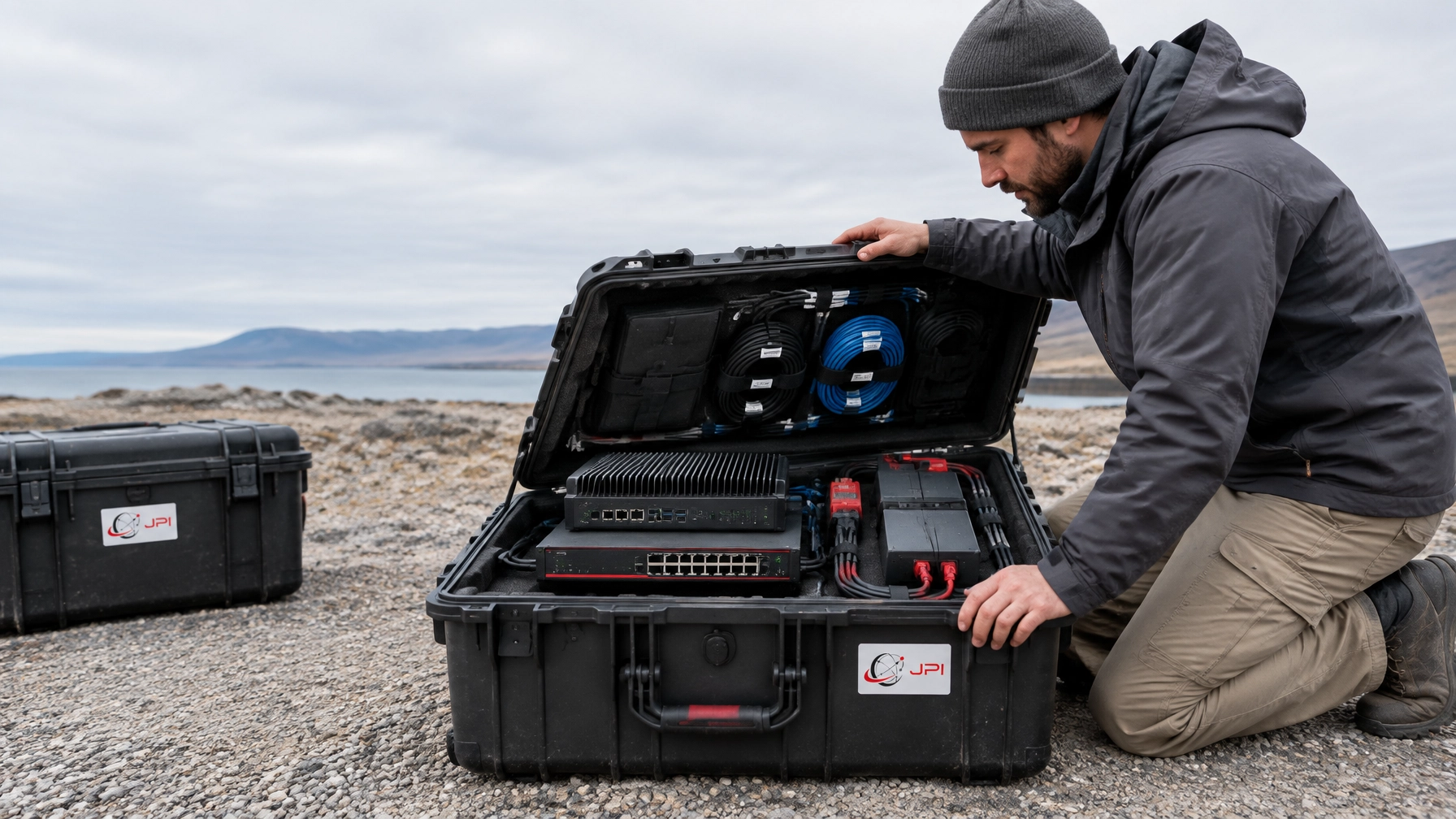
Edge compute places processing and storage near the user, sensor, network, or operational system. In OCONUS environments, the equipment must also fit within practical constraints involving size, weight, and power, commonly referred to as SWaP.
Low-SWaP edge computing means delivering the required local processing capability with the smallest practical equipment, weight, power demand, cooling burden, and sustainment requirement.
Low-SWaP design does not mean selecting the smallest available device without regard to mission requirements. A compact platform that overheats, lacks storage, or cannot be maintained in the field may create more operational friction than a larger but properly engineered system.
The baseline should address:
- Processing requirements for local inference.
- Storage capacity for queued data, logs, and approved reference material.
- Power input, battery or generator limitations, and safe shutdown.
- Thermal management and environmental protection.
- Hardware replacement and spare-equipment planning.
- Local network interfaces and segmentation.
- Secure configuration and access controls.
- Operator and maintainer skill requirements.
Model selection should occur alongside hardware selection. A model that performs effectively in a centralized environment may require quantization, compression, pruning, or a different inference approach at the edge. The objective is to maintain an acceptable level of function without creating unnecessary hardware or power dependencies.

3. Use store-and-forward data flows
A store-and-forward architecture allows an edge node to collect, process, and retain data locally until an approved connection becomes available. Once connectivity is restored, the system synchronizes selected information according to policy.
The architecture should not automatically transmit every file, event, or model output. Data should be triaged before synchronization.
A practical flow includes:
- Local collection: Gather data from approved systems, sensors, applications, or operator inputs.
- Local triage: Classify data by operational value, sensitivity, urgency, and transmission cost.
- Local inference: Apply approved AI functions and record the result with an audit trail.
- Connection detection: Identify when an authorized communications path is available.
- Policy-controlled synchronization: Transmit only approved records, logs, updates, or requests.
- Command-node validation: Review, accept, reject, or return information and configuration changes.
The system should use queues with defined priorities. Critical system-health information may receive a higher priority than bulk telemetry. A summary or extracted feature may be transmitted before the original data set when policy permits.
Synchronization should also support interruption. If a link fails during transfer, the system should preserve data integrity, record the transfer state, and resume or restart according to documented rules.

4. Manage data, models, and updates over constrained links
Model management becomes more difficult when the network cannot support large or frequent transfers. Updates must therefore be treated as controlled configuration changes rather than routine downloads.
The technical baseline should maintain version records for:
- AI models.
- Model weights and supporting files.
- Application containers.
- Operating systems and dependencies.
- Configuration files.
- Data schemas.
- Security policies.
- Prompt, retrieval, or agent instructions.
Each update should have an identified source, integrity verification, compatibility assessment, rollback path, and test record. The edge node should be able to continue operating on the last approved version if an update is incomplete or fails validation.
The January 2026 Department of War AI strategy directs the establishment of a delivery and integration cadence intended to support rapid model updates. In a constrained OCONUS environment, that objective requires more than a fast release schedule. It requires a transport and sustainment process that can function when links are intermittent.
Practical methods may include:
- Shipping approved updates through controlled physical media where permitted.
- Transmitting only changed components rather than full packages.
- Compressing models and supporting data.
- Scheduling updates during defined synchronization windows.
- Maintaining multiple approved model versions.
- Separating urgent security patches from optional capability updates.
- Testing updates on a representative edge platform before deployment.
- Recording update status locally until confirmation is received.
Model updates should not be treated as automatically beneficial. Performance, resource consumption, data compatibility, and security implications should be evaluated before the update is released to an operational node.
5. Design for graceful degradation
Graceful degradation means that a system reduces capability in a controlled manner rather than failing unpredictably when a dependency is unavailable.
An AI system may operate through several defined modes:
- Connected mode: Full authorized integration with enterprise services.
- Constrained mode: Reduced bandwidth, delayed synchronization, or limited external services.
- Disconnected mode: Local inference, local data access, and local audit logging.
- Recovery mode: Controlled synchronization, validation, reconciliation, and service restoration.
Each mode should have known limitations. Operators should be able to see whether the system is connected, what data is current, which services are unavailable, and when the last successful synchronization occurred.
The system should also establish safeguards for stale or incomplete data. AI outputs based on old records may require a different confidence designation or additional human review. If required data is unavailable, the system should state that limitation rather than implying that the result is complete.
Graceful degradation should include:
- Local status displays.
- Clear alerts for stale data.
- Manual override and disengagement procedures.
- Local audit logs during outages.
- Recovery testing after link restoration.
- Data reconciliation procedures.
- Defined escalation routes.
- Training for operators and maintainers.

Q&A: AI for disconnected OCONUS missions
What is the main advantage of edge AI in a disconnected environment?
The principal advantage is local availability of defined AI functions when continuous access to a centralized cloud or enterprise network cannot be assumed. Edge AI does not eliminate the need for centralized systems. It provides a controlled local capability for selected workloads.
Is store-and-forward the same as real-time connectivity?
No. Store-and-forward systems are designed for delayed or intermittent exchange. They collect and process data locally, then synchronize selected information when an approved connection is available.
What does low-SWaP mean for defense IT solutions?
Low-SWaP refers to reducing the size, weight, and power requirements of the deployed technology while preserving the processing, storage, security, and environmental capabilities required by the mission.
How should AI model updates be handled in disconnected environments?
Updates should be version-controlled, integrity-checked, tested, documented, and capable of rollback. The system should continue operating on the last approved version if a new update is incomplete, incompatible, or not authorized.
What should primes require from an edge AI subcontractor?
Primes should require documented interfaces, defined degraded-mode behavior, cybersecurity controls, data and model governance, test evidence, human-oversight procedures, configuration management, field support, and sustainment responsibilities. A successful demonstration alone does not establish deployment readiness.
How JPI Worldwide can support implementation
JPI Worldwide supports AI and systems integration, network engineering, cybersecurity, communications, technical staffing, logistics, and field deployment. These capabilities can be combined to reduce integration friction for primes and government organizations implementing edge AI in CONUS and OCONUS environments.
JPI may support:
- Edge-compute and network architecture planning.
- Store-and-forward communications and synchronization design.
- AI-enabled workflow and systems integration.
- Network segmentation, secure access, and monitoring.
- Hardware staging, configuration, and field installation.
- Operational testing and troubleshooting.
- Technical staffing for deployment and sustainment.
- Training, documentation, and system handoff.
- Equipment movement and deployment coordination.
JPI’s government support capabilities are structured for requirements that extend beyond software delivery. Infrastructure, personnel, logistics, cybersecurity, and sustainment may all affect whether an AI capability remains useful after deployment.
Contact JPI Worldwide
Potential partners, technical leads, prime contractors, government agencies, and departments evaluating network deployment services or defense IT solutions may contact JPI Worldwide to discuss a requirement.
Do not submit classified information, Controlled Unclassified Information, export-controlled technical data, passwords, credentials, or other sensitive material through the public contact form. Contact JPI directly if the requirement requires a secure communications method.