
Page: Technology Infrastructure and Mission Support
Revision date: September 17, 2026
Author: Penny Marbel (JPI Worldwide)
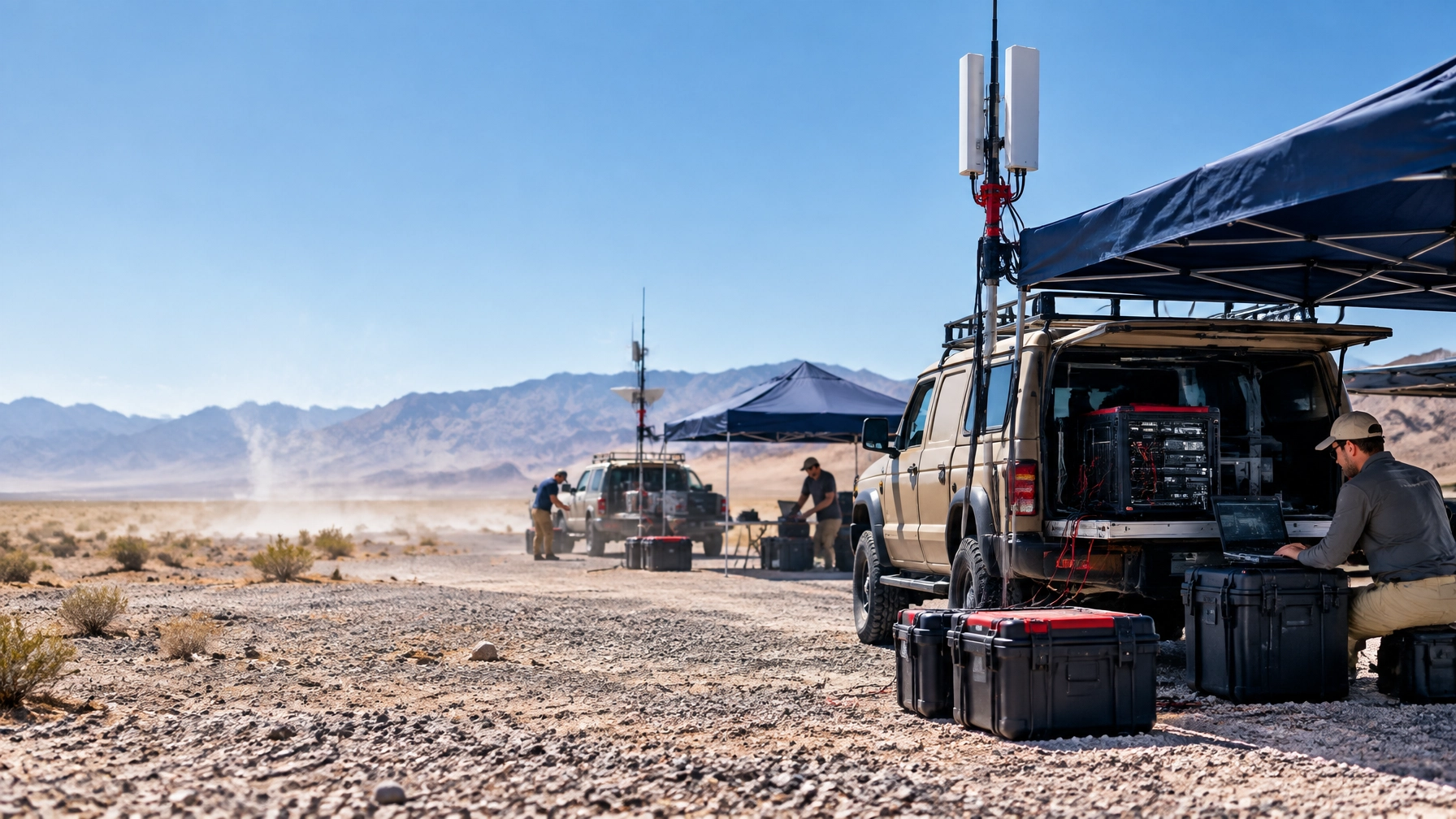
During the Army’s Project Convergence Capstone 6 exercise in July 2026, some commercial Starlink ground terminals experienced overheating in more than 100-degree desert heat. The elevated temperatures reduced data throughput. Soldiers responded by soaking T-shirts in water and placing them over the terminals to provide evaporative cooling and shade.
The event was not merely an anecdote about field improvisation. It was a practical demonstration of the engineering and acquisition decisions that affect tactical communications and telecom infrastructure in demanding environments.
Commercial technology may provide speed, availability, and lower acquisition cost. Ruggedized equipment may provide greater environmental margin. Neither category is automatically appropriate for every mission. The relevant question is whether the complete system, operating procedure, and sustainment model are suitable for the conditions in which the government expects the capability to function.
Quotable definition: Thermal management is the planned control of heat entering, accumulating within, and leaving a system so that the system remains within its operating limits.
The following five lessons are intended for government buyers, contracting officers, program managers, and prime contractors evaluating communications capabilities for field use.
1. Test the Environment, Not Only the Equipment
A technology evaluation should reproduce the environmental conditions that may affect mission performance. Laboratory specifications and manufacturer data are necessary, but they may not capture the combined effect of direct solar loading, reflected heat, dust, restricted airflow, vehicle exhaust, power-conversion losses, and continuous operating cycles.
The Starlink trial illustrated how a system that performs adequately in ordinary commercial conditions may encounter limitations when placed in direct sun and extreme heat. Throughput degradation may be operationally significant even when the equipment does not immediately fail.
For a government buyer, the solicitation and evaluation plan should identify applicable environmental conditions, including:
- Ambient temperature and solar exposure
- Dust, sand, humidity, precipitation, and wind
- Vehicle-mounted or enclosed operating conditions
- Available power and power-quality limitations
- Expected duty cycle and peak traffic demand
- Required data rates during degraded conditions
- Maintenance access and replacement procedures
Environmental testing should also examine system performance rather than equipment survival alone. A terminal that remains powered on but reduces throughput below the mission requirement may not satisfy the intended operational need.

2. Treat Thermal Management as Part of the Architecture
Thermal management should be addressed during system design. It should not be treated as an afterthought assigned to field personnel after deployment.
Possible design measures may include:
- Shade structures that do not obstruct required signal paths
- Reflective barriers or coatings
- Ventilated equipment enclosures
- Active cooling or vehicle-integrated cooling systems
- Temperature sensors and threshold alerts
- Equipment spacing that preserves airflow
- Power systems sized to avoid unnecessary heat generation
- Preventive cleaning and inspection procedures
The Army’s reported consideration of additional cooling solutions, including vehicle-integrated systems, reflects a broader architectural principle. A terminal may be only one component of a larger communications package. The vehicle platform, power distribution, enclosure, network equipment, and environmental controls may determine whether the terminal can remain useful under operational conditions.
A contracting officer should therefore avoid specifying a communications terminal without defining the surrounding integration requirements. The statement of work should identify who is responsible for mounting, cooling, power, cable routing, environmental protection, monitoring, and corrective maintenance.

3. Document Field Expedients Without Making Them the Primary Control
The wet-T-shirt solution demonstrated practical field ingenuity. It also showed why field expedients should be documented, evaluated, and incorporated into training when they are safe and operationally appropriate.
A field expedient is a temporary or improvised method used to maintain or restore system function when the planned configuration is insufficient or unavailable. It may be useful when:
- The method does not create an electrical, safety, or contamination hazard.
- The method does not interfere with signal performance or equipment operation.
- Personnel can apply the method consistently.
- Required materials are available in the operating environment.
- The method has been tested or approved through an appropriate technical process.
- The method does not conceal a recurring design deficiency.
The existence of a simple workaround does not establish that a system is ready for broad deployment. A wet cloth may provide short-term cooling under particular conditions. It may not be appropriate for prolonged operation, freezing conditions, sensitive electrical interfaces, water-constrained environments, or systems requiring unattended service.
Government buyers should require a clear distinction between:
- Designed capability, which is part of the approved system configuration.
- Approved operating procedure, which is trained and documented.
- Emergency field expedient, which may be used only under defined conditions.
- Corrective engineering action, which addresses a recurring or unacceptable limitation.
This distinction protects both mission performance and contract accountability.
4. Buy for the Mission, Not for a Category Label
“Commercial” and “ruggedized” are useful descriptors, but they do not replace requirements analysis. Commercial technology may be faster to procure, easier to update, and less expensive than a bespoke military system. Ruggedized equipment may offer greater environmental tolerance, but it may also increase cost, lead time, weight, power demand, and maintenance complexity.
The Army’s experience supports a risk-based approach. A government customer should determine where additional ruggedization is necessary and where a commercial solution, protective integration, or documented operating procedure may provide sufficient value.

The graphic above is a conceptual procurement aid. It is not a product specification, test result, or formal rating of any particular system.
The acquisition analysis should consider:
- Consequences of degraded throughput
- Required availability and restoration time
- Environmental exposure and deployment duration
- Cost of replacement equipment and field labor
- Availability of spare parts and technical support
- Weight, power, and transportation constraints
- Cybersecurity and network-integration requirements
- Whether the system will operate attended or unattended
- The cost of over-ruggedizing equipment that could be protected through integration
A commercial-first strategy can reduce cost and accelerate fielding. It does not eliminate the need for environmental testing, integration engineering, or sustainment planning.
5. Sustain the Whole System
Tactical communications reliability depends on more than the terminal or radio. It depends on the complete telecom infrastructure package and the personnel responsible for operating it.
A sustainment plan should address:
- Configuration control and technical documentation
- Operator and maintainer training
- Environmental inspection criteria
- Temperature and throughput monitoring
- Spare equipment and replacement components
- Troubleshooting and escalation procedures
- Cooling, shade, power, and enclosure requirements
- Network failover and alternate communications paths
- Equipment movement and resupply
- Corrective-action reporting and lessons learned
Prime contractors should also define subcontractor responsibilities before deployment. Unclear interfaces between the equipment vendor, network integrator, field technician, logistics provider, and government customer can increase operational friction.
JPI Worldwide supports primes and government customers with network engineering and infrastructure, satellite and communications integration, cybersecurity, technical staffing, logistics, field installation, troubleshooting, and sustained operational support. These capabilities may be combined into a defined subcontract work package covering design, staging, deployment, testing, and sustainment.
JPI Deployment Component
JPI may support a prime contractor or government program by providing the technical component required to move a communications capability from procurement to field operation. Depending on the requirement, that component may include:
- Environmental and site-readiness assessments
- Vehicle or facility integration
- Network and power coordination
- Equipment staging and configuration
- Field installation and acceptance testing
- Thermal monitoring and maintenance procedures
- Operator training and technical documentation
- Spare-parts and replacement planning
- CONUS and OCONUS field support
The final scope should be established by the statement of work, system architecture, security requirements, operating environment, and applicable law.

Frequently Asked Questions
What happened to the Starlink terminals during Project Convergence Capstone 6?
During the July 2026 exercise, some commercial ground terminals overheated in extreme desert heat. The resulting thermal throttling reduced data throughput. Soldiers used water-soaked T-shirts as an improvised cooling measure.
Does the incident mean commercial technology is unsuitable for government missions?
No. It demonstrates that commercial technology must be evaluated against the actual environmental and operational requirements. Commercial equipment may be suitable when it is properly integrated, protected, monitored, and supported.
Is ruggedized equipment always the better procurement choice?
No. Ruggedization may increase cost, weight, power consumption, and lead time. The appropriate choice depends on mission consequence, environmental exposure, availability requirements, and the effectiveness of alternative controls.
What should a contracting officer include in a tactical communications requirement?
The requirement should address environmental conditions, throughput under degradation, thermal management, power, mounting, cybersecurity, network integration, testing, training, spares, field support, and corrective-action procedures.
How can JPI support a tactical communications program?
JPI may provide communications integration, network infrastructure, cybersecurity, technical personnel, logistics, field deployment, troubleshooting, and sustainment support. Government and prime-contractor support capabilities are described here.
Contact JPI Worldwide
Government agencies, contracting officers, prime contractors, and mission partners evaluating tactical communications or broader telecom infrastructure may contact JPI Worldwide to discuss the technical and operational requirement.
JPI can review:
- Commercial and ruggedized equipment tradeoffs
- Thermal management and environmental testing
- Vehicle, facility, and field integration
- Network architecture and secure access
- Redundant communications paths
- Technical staffing and field services
- Logistics, spares, and sustainment
Use the JPI Worldwide contact page or email connect@jpiworldwide.com. Do not submit classified information, Controlled Unclassified Information, export-controlled technical data, passwords, credentials, or other sensitive information through a public contact channel.
Sources
- Breaking Defense: Wet Tees on Sat Links: Army’s Desert Trial Reveals Commercial Tech Challenges and Opportunities
- Breaking Defense: Project Convergence to Stress-Test Next-Gen Communications Gear in Sweltering Desert
- JPI Worldwide: Integrated Technology Capabilities
- JPI Worldwide: Government Technology and Mission Support